Chapter Seven: Regular Combatants


Previous Page (Chapter Six: Siege Weapons) - Table of Contents - Next Page (Chapter Eight: Irregular Combatants)
Chapter Sections:
The Chain of Command
Way back in the distant early days of Galctic War, there
was only one kind of SpaceTrooper - the SpaceMan. At first, battlefield
organization was very strong - SpaceMen grouped themselves in squads of
four men, with one man serving as radio operator to keep them coordinated
with the rest of the attack. But the radio operators kept getting
killed, and without radio guidance, their squads would wander around in
confusion and get lost.
After a while, the StarShip Civilizations began designing a more
independent breed of SpaceMan. These had no need of organization
or centralized control, relying on keen instinct, the collective subconscious,
and studies of The Zen of Large-Scale Assault Maneuvers to keep coordinated.
This was the Golden Age of SpaceCombat, when the SpaceMen answered to no
one but themselves on the battlefield.
And then, the variant SpaceTrooper designs started popping up.
SpaceScouts. SpaceNinjas. SpaceWomen. All SpaceMen were
no longer created equal. It was time to re-implement the organized
battle maneuver, with a carefully layered chain of command.
The SpaceTroopers of a StarShip Civilization are the men, women, and
droids who risk their lives in an effort to destroy as many enemies and
as much enemy property as possible, all in the name of their home Civilization.
There a number of SpaceTroopers, and their abilities are all very different.
From the all-around utility of the SpaceMan, to the highly specialized
(and useful) special troops, like Medix and Mechanix, each SpaceTrooper
has their part to play during the course of a battle. In a BrikWars
game, each Civilization is represented by a single color (or group of colors,
if there aren't enough minifigs of a single color). All SpaceTroopers
wear suits of a consistent, single color, and helmets and AirTanx, unless
otherwise specified.
Troop Ratios
With all the new breeds of warrior introduced in this chapter, there
are a couple more things to consider than when we were limited to the basic
SpaceMan. The first is the Troop Ratio statistic. Each type
of unit has one. These are designed to limit the number of extremely
powerful units. Most units will be rated as 'Troops', meaning they
are pretty basic and you can have however many you like. For other
units there is a ratio requirement. You have to buy seven Troop-rated
units before you can buy each additional SpaceNinja, for instance.
For the most part, units with a higher Troop Ratio requirement outrank
those with lower requirements. (The exception is the Synthetik, who
despite his Troop Ratio stat of 5, is outranked by everyone.)
Stupendous Feats
Some new unit types have special abilities. Most of these will
be detailed in the unit description in each section. One new and
important ability that a couple of the Heroic units share is the ability
to perform Stupendous Feats. There are all kinds of Stupendous Feats;
these examples are only a few:
- Shooting again (no automatic hits)
- Moving again
- Grabbing hold of a passing vehicle/flyer
- Punching a hole in a wall
- Climbing sheer surfaces
- Moving something big
- Leaping great distances
- Troubleshooting medical help for a fallen trooper
- Fixing a vehicle
- Throwing objects great distances
- Moving terrain features
- Etcetera
In order for a Hero to perform a Stupendous Feat, the player declares exactly
what kind of feat he is trying to accomplish, and then rolls 1d6.
If his opponent wants the attempt to fail (and he usually will), then he
also rolls 1d6. If the player attempting the feat rolls equal to
or higher than his opponent, then the feat succeeds. If the Feat
fails, the Hero suffers whatever fate would normally befall someone who
attempted such a thing. For instance, if a Hero failed in his attempt
to eat the World's Biggest Hoagie, he would eat a large portion of it and
then have bad stomach pain. If a Hero failed in his attempt to make
a standing long jump across the Chasm of Grisly and Horrifying Death, then
he would jump partway across and then fall into the Chasm.
Stupendous Feats can be as silly as the players desire. A very
serious game could be played with very strict rules on which types of feats
can be performed, or players can choose to allow such things as eating
obstructions or drinking rivers dry. It usually works best to imagine
some role model for your range of Stupendous Feats. In a more serious
game, your SpaceHeroes might have all the abilities of a Green Beret, General
MacArthur, or an Airborne Ranger. More commonly, we limit them to
anything you might expect to see in a typical action movie, giving them
the abilities of Rambo, James Bond, Bruce Lee, Conan the Barbarian, or
Jackie Chan. And every now and then we set our sights a little higher,
with the abilities of Superman, or Zeus, or God. We leave the restrictions
on silliness to the players' taste, but we suggest a high level of stupidity.
We do not describe all possible Stupendous Feats because there are any
number of actions a Hero can take. So many options exist that we
leave it up to the players to think of something silly for their Heroes
to do. We like to have our Heroes pick up vehicles and throw them
at other vehicles. Our Heroes do a lot of Really Fast Running and
400-Meter Leaps, as well.
Tactical Division
The tactical division rules are the most optional of our optional rules.
It's the kind of thing that you're sometimes really in the mood for, and
sometimes you can't stand. And sometimes you change your mind in
the middle of a battle. So we've divided them up into three flavors,
in order of incresing complexity: Independent, which is the model used
in the first edition of BrikWars; Squads, which was the pre-BrikWars model;
and Battallions, which is the new model introduced here, like Squads but
more so.
Independent
This system is very simple and easy to learn. Basically, all
your soldiers on the field do whatever they like. They have some
kind of psychic power telling them where all the other units are on the
battlefield, and where they are in relation to them. They do not
get confused or disorganized. The Fog of War does not exist for these
men.
Squads
All units on foot are arranged in squads of three to five troops.
These squads move together, attack together, eat together, think together.
If one member of a squad gets lost, the other members have to find him.
If one member gets shot, the other members drag him back to the Medix.
Each squad must have at least one guy with a Radio. (Vehicles, Synthetix,
ComputerBanx, and gun emplacements all have radios built into them.)
If they lose that radio, then they become disoriented and confused.
If there is an obvious enemy target for them to attack, they attack it;
otherwise, each turn that one of your squads is wandering around without
radio contact, you and your opponent both roll 1d6. If you roll higher,
or it is a tie, then you control the squad during their Movement Phase.
Otherwise, your opponent chooses how they move. (You should set limits
on how unrealistic this is. Obviously, they're not going to use their
Movement Phase to drop all their weapons and take off all their clothes,
no matter what your opponent thinks.) You will always control them
during their Attack Phase, no matter who moved them, and they can shoot
at whatever they're facing.
Battallions
Battallion mode is the most complex system. Not only are troops
organized into squads, but their radios are useless unless someone of higher
rank is sending them commands over it. A definite Chain of Command
is established, usually with a SpaceChampion commanding a base and a group
of some SpaceHeroes, who in turn command seperate legions of Troops.
Units can only use their radios to speak to other units directly above
or below themselves in the Chain of Command, so if a link in that chain
is taken out, communication will be disrupted. If a unit's commanding
officer is killed or loses contact, the unit will continue following whatever
his last order was (hopefully it was something useful like "conquer and
hold the enemy base" rather than "head east until I tell you to stop."),
and then wait for additional orders, doing normal things like defending
himself if attacked and attacking enemies who come into range. He
has no idea what is going on on the battlefield outside of his own field
of vision, and he cannot get the authorization to help other divisions
complete their separate missions.
What can you do with these poor abandoned subordinates? If somebody
sees that the commanding officer has been killed, he can get on the radio
and start notifying people, or tracking them down and notifying them face
to face. This might be because he was standing next to the officer
and saw him get hit by the Death Beam, or because somebody sent him to
check the officer's last known position when contact was lost, or because
they just happened to wander across his bloody corpse. Different
soldiers will react in different ways to news of an officer's death.
Superior commanding officers will arrange for someone to take command of
all those soldiers who no longer have a commander. Officers with
rank equivalent to or higher than the fallen officer may collect his radio,
giving them instant command of all his former units, or may send units
out to notify the fallen officer's subordinates face-to-face, so that they
can change their radios to the new officer's frequency and start following
his orders. Subordinates to the fallen officer realize that they
are now independent, and may now act in whatever way seems best to them.
Their radios are cut off from their allies', so they cannot engage in coordinated
attacks with other independent groups, even if they're on the same side.
You can see that if you lose your Commander-In-Chief, you're suddenly going
to have a number of independent divisions that won't play together well;
so do what you can to keep him alive!
Some Civilizations, like those of the MedievalMen, RennaissanceMen,
and CaveMen, have no CB Radio technology. If they are going to survive
in the Battallion system, they have to either have big signal banners,
buglers, smoke signals, runners, or some other form of transmitting their
orders across a battlefield. Usually, subordinate units have to send
runners if they want to communicate back to their superiors.
Return to the top of the page.
SpaceMen
| The SpaceMan |
|
| Move: |
5" |
| Armor: |
5 |
| Skill: |
1d6 |
| Ratio: |
None(troop) |
| Points: |
5 |
 SpaceMen
are the standard troopers of any Starship Civilization. They are
represented by a 'normal' space minifig. For more information on
SpaceMen and how troop statistics work, please see the Our
Hero, the SpaceMan section of Chapter One: The BrikWars
Quickstart Guide.
SpaceMen
are the standard troopers of any Starship Civilization. They are
represented by a 'normal' space minifig. For more information on
SpaceMen and how troop statistics work, please see the Our
Hero, the SpaceMan section of Chapter One: The BrikWars
Quickstart Guide.
Return to the top of the page.
SpaceWomen
| The SpaceWoman |
|
| Move: |
7" |
| Armor: |
1d4+2 |
| Skill: |
1d6 CC+2 |
| Ratio: |
None(troop) |
| Points: |
6 |
 SpaceMen
once held the title for being the most destructive beings in the universe,
but now, they are tied for that title with the SpaceWomen. Once confined
to minor skirmishes and ladies' auxiliary clubs, the women of the BrikWars
universe have carved a niche for themselves among the deadliest of warriors.
SpaceMen
once held the title for being the most destructive beings in the universe,
but now, they are tied for that title with the SpaceWomen. Once confined
to minor skirmishes and ladies' auxiliary clubs, the women of the BrikWars
universe have carved a niche for themselves among the deadliest of warriors.
SpaceWomen are highly trained female warriors who wear special suits
of SpaceArmor, designed by women, with fashion and utility in mind.
SpaceWomen's armor is specially equipped with a Neural Synapse Accelerator,
designed to give SpaceWomen a unique combat attribute. Because of
this special equipment, SpaceWomen are faster and more agile than SpaceMen,
and their natural viciousness in close combat is enhanced (for information
about how their +2 Close Combat bonus works, see the Close
Combat section of Chapter Three: Advanced Combat).
However, this equipment was added at the cost of some protection.
SpaceWomen are represented by a normal SpaceMan piece, but instead of
a SpaceHelmet, SpaceWomen wear a "girl-hair piece," to designate them as
SpaceWomen, and so they look like they just stepped out of a salon.
SpaceWomen look down on the SpaceMen who insist that they need helmets
to survive harsh space environments. There is no limit to the number
of SpaceWomen allowed; you can have as many SpaceWomen as you have girl-hair
pieces.
Return to the top of the page.
SpaceScouts
| The SpaceScout |
|
| Move: |
12" |
| Armor: |
1d6 |
| Skill: |
1d4 |
| Ratio: |
5 |
| Points: |
8 |
 SpaceScouts
are usually taken from the ranks of the newly initiated SpaceTroopers.
Since they have no true battle-experience, these troopers are given the
opportunity to act as SpaceScouts for a time. They undergo a rigorous training
regimen for a day or two, consisting of some jogging and swimming at the
local YSMCA, and upon completion, they are given a suit of ScoutArmor.
SpaceScouts
are usually taken from the ranks of the newly initiated SpaceTroopers.
Since they have no true battle-experience, these troopers are given the
opportunity to act as SpaceScouts for a time. They undergo a rigorous training
regimen for a day or two, consisting of some jogging and swimming at the
local YSMCA, and upon completion, they are given a suit of ScoutArmor.
ScoutArmor is hardly armor at all, but the suit gives the trooper several
abilities useful to his Civilization. ScoutArmor is lighter and thus
allows the trooper to move much more quickly. The armor is also equipped
with a special targeting system, which allows enemy targets to be "tagged"
for weapons fire, making a direct hit more likely.
Scouts are a tremendously secretive bunch, and have many rituals in
which they pray that they will not be blasted by a Mk5 Missile. It
is in these rituals that the SpaceScouts shave their heads in a ceremony
known as "The No-More-Hair Ritual". SpaceScouts are represented by
a normal SpaceMan minifig, except that their heads have been shaved in
this closely guarded ritual, known only to the SpaceScouts themselves.
Thus, SpaceScouts wear nothing on their heads (i.e. no helmets or hair
or hats). SpaceScouts do not wear AirTanx, either.
The only weapons SpaceScouts are allowed to carry are Gyro and Impact
Pistols, and non-ranged close combat weapons that do not confer movement
penalties. SpaceScouts are not allowed any other armor besides their
ScoutArmor. They must carry a CB Radio at all times to relay vital
information. You can only field one SpaceScout for every 5 regular
troops.
However, despite these restrictions, SpaceScouts still have their uses.
SpaceScouts have the ability to "Tag" enemy vehicles and units for his
army's ranged weapon fire. In order to tag an enemy vehicle or unit,
the SpaceScout must be within 6" of the target, and be able to see it.
As long as he can see the target unit or vehicle, anybody allied with the
SpaceScout may shoot at it, from anywhere on the board. Even if the
rest of the SpaceScout's army is behind a large wall, blindfolded, and
thinks the enemy is coming from the south when they're actually in the
north, they may still fire at the "tagged" enemy. They even get a
+1d6 Skill bonus for shooting at a tagged enemy. Normal Ranged Attack
modifiers still apply, except if you're using a weapon that you can toss
over the tops of obstacles (like grenades, missiles, Ballistik weapons),
then cover will not help the target.
A SpaceScout may only tag one target at a time. If he is within
6" of two potential targets and can see them both, then he must specify
which one is being tagged. Multiple SpaceScouts tagging a target
confers only one bonus To Hit; that is, more than one SpaceScout may tag
a target, but only one bonus is given.
Return to the top of the page.
Synthetix
The Synthetik
or SpaceDroid |
|
| Move: |
7" |
| Armor: |
1d6+2 |
| Skill: |
1d10 |
| Ratio: |
5 |
| Points: |
8 |
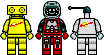 Synthetix,
or SpaceDroids, are human shaped and sized robots which can fight alongside
a regular SpaceMan. The members of the squad to which the SpaceDroid
belongs constantly repair and upgrade their comrade, and treat it as if
it were a real man.
Synthetix,
or SpaceDroids, are human shaped and sized robots which can fight alongside
a regular SpaceMan. The members of the squad to which the SpaceDroid
belongs constantly repair and upgrade their comrade, and treat it as if
it were a real man.
Due to the fact that the android is not human, and made from synthetic
materials, it is more durable and can move faster than can a normal SpaceMan.
They have built-in CB Radios, so their squad doesn't need to carry one.
Androids, however, are not autonomous creations, and must be attached to
a squad of other SpaceTroopers.
SpaceDroids are basically human SpaceMan pieces, but with an odd mechanical
feature or two. These features can range from having a maneuver jet
for a head, to having wheels instead of legs. However, the heads
of SpaceDroids cannot be the normal human face, and must be some other
piece (SpaceDroids aren't technologically advanced enough to support human
features, yet).
A SpaceDroid must be in a squad, vehicle, or base with at least one
human SpaceMan in it. If all of the humans in the SpaceDroid's squad
die, then the Droid will return to the nearest squad or base to receive
new orders, at which time he can join a new squad. It is possible
to have a squad of four SpaceDroids and one human, if you really want to.
There must be at least one friendly human within 5" of each Droid, or the
Droid will go into a RoboPanik and do whatever he can to get to the nearest
friendly humans.
Return to the top of the page.
SpaceSlaves
The SpaceSlave
or SpaceMenial |
|
| Move: |
6" |
| Armor: |
1d4 (10) |
| Skill: |
1d4 (10) |
| Ratio: |
None(troop) |
| Points: |
4 |
 SpaceMenials
are unfortunate mutants, genetik accidents who are mind-numbingly pacifistic.
They cannot raise a weapon or fist in anger to hurt another. As it
becomes apparent to their teachers that they are Violence Challenged, they
are taken aside into Special Education classes. There they are taught
the skills of the SpaceSlave, like pulling plows and carrying wrecked cars
to the dump and other menial tasks. All the while, they are dosed
with whatever experimental steroids are in vogue. This does not make
them very intelligent, but they do become very strong.
SpaceMenials
are unfortunate mutants, genetik accidents who are mind-numbingly pacifistic.
They cannot raise a weapon or fist in anger to hurt another. As it
becomes apparent to their teachers that they are Violence Challenged, they
are taken aside into Special Education classes. There they are taught
the skills of the SpaceSlave, like pulling plows and carrying wrecked cars
to the dump and other menial tasks. All the while, they are dosed
with whatever experimental steroids are in vogue. This does not make
them very intelligent, but they do become very strong.
Although snubbed by the other SpaceMen, SpaceMenials have one great
advantage: for the purpose of lifting, carrying, throwing, and shoving
things around, their effective Skill and AV are 10. This means they
can carry some small vehicles without slowing down! They are useful
for quick assembly and disassembly of barricades and fortifications, and
are often used to check for anti-personnel mines, as target dummies, to
draw enemy fire, or as target practice when all the Civilians are dead.
SpaceMenials have no SpaceArmor, they just run around in OverAlls and
a BaseballCap or HardHat, in the color of their Civilization. If you have
any old minifig heads whose faces have rubbed off, and you had to draw
new faces with a Sharpee pen, and you slipped a little and the new faces
look retarded, then those make the best SpaceMenial heads. Also,
Timmy makes an excellent SpaceMenial. In our games, any soldier who
spots Timmy (even one of his allies) must drop everything and destroy him
on sight. Infestations of twenty or thirty Timmys have led the bitterest
enemies to form Anti-Timmy Alliances. No Medik will try to save a
Timmy, although they might use him for experimentation. For this
reason, a Timmy only costs one point.
Return to the top of the page.
SpacePilots
The SpacePilot
or SpaceDriver |
|
| Move: |
5" |
| Armor: |
1d4 |
| Skill: |
1d6+2 |
| Ratio: |
one per vehicle(troop) |
| Points: |
6 |
 SpacePilots
are the elite and cocky group of warriors who pilot the vehicles of their
army. While any SpaceTrooper can pilot a vehicle, the SpacePilots
have the talent and education that give them the edge in vehiclular combat.
SpacePilots
are the elite and cocky group of warriors who pilot the vehicles of their
army. While any SpaceTrooper can pilot a vehicle, the SpacePilots
have the talent and education that give them the edge in vehiclular combat.
Before becoming a full-fledged SpaceDriver, the Initiate must pass
a special course called "SpaceDrivers' Ed," which is offered at the local
high school. In SpaceDrivers' Ed, the Initiate learns such vital
things as how to drive in a straight line, how to operate the weapons and
communications systems of his vehicle, and how to parallel park.
Once a SpaceDriver is given his first vehicle, he takes tremendously
good care of it. On the weekends, with the week's fighting behind
him, the SpaceDriver tends to his vehicle. SpaceDrivers follow a
grueling ritual which involves meticulously waxing, polishing, and detailing
their vehicle. After the external ointments have been applied, the
SpaceDriver carefully tunes the engine, with the help of his unit's Mechanix.
Finally, he vacuums inside the vehicle, and cleans up the floormats.
He rotates the tires, too, if the vehicle has any.
Every armed vehicle must start out with a SpacePilot. The SpacePilot
might get killed in the middle of the battle, and then any SpaceMan can
come along and commandeer his vehicle, but the vehicle has to start the
battle with a SpacePilot. Unarmed vehicles can start out with whomever
they like, since it's not as important that they have a skilled gunner
in the pilot's seat.
A SpacePilot is represented by a SpaceMan with a visored racing helmet
and no AirTanx.
Return to the top of the page.
Mechanix
| The Mechanik |
|
| Move: |
5" |
| Armor: |
5 |
| Skill: |
1d8 |
| Ratio: |
max. one per vehicle |
| Points: |
8 |
 Mechanix
are members of the elite order that repairs and maintains the vehicles,
bases, and installments of the SpaceMen. When a potential Mechanik
is identified in the SMTC, he is immediately given an aptitude test to
determine whether or not he would make a skilled Mechanik. SpaceMen
who are trained as Mechanix spend an extra 20 years in training at the
Citadel of Mechanix. In the Citadel, the Mechanik trainee is trained
how to design, test, and finalize designs of machinery in his head.
The skilled Mechanik can design a new vehicle from the wreckage of another
in about ten seconds, the fastest Mechanix can do it in five. Mechanix
require tools with which to work, and many of the sets of tools that the
Mechanix use have been in circulation for thousands of years, handed down
from generation to generation.
Mechanix
are members of the elite order that repairs and maintains the vehicles,
bases, and installments of the SpaceMen. When a potential Mechanik
is identified in the SMTC, he is immediately given an aptitude test to
determine whether or not he would make a skilled Mechanik. SpaceMen
who are trained as Mechanix spend an extra 20 years in training at the
Citadel of Mechanix. In the Citadel, the Mechanik trainee is trained
how to design, test, and finalize designs of machinery in his head.
The skilled Mechanik can design a new vehicle from the wreckage of another
in about ten seconds, the fastest Mechanix can do it in five. Mechanix
require tools with which to work, and many of the sets of tools that the
Mechanix use have been in circulation for thousands of years, handed down
from generation to generation.
Mechanix are handy to have around. Not only can they repair damage
done to vehicles, but they can salvage parts from wreckage and create new
devices in the midst of battle. A Mechanik must be equipped with
a least one wrench, hammer, robot arm (we use this piece as a tool), or
other kind of tool. Tools cost 5 points apiece. They also get
to wear little police hats. They don't generally carry any weapons,
although they can pick them up off of fallen troopers and use them if they
get in a tight spot.
Mechanix have two roles to play on the battle field: they can repair
damaged vehicles, or they can build new vehicles out of wreckage.
Repairing Damaged Vehicles
A Mechanik can help to fix vehicles which have suffered damage as a
result of collisions or weapons fire. When a Mechanik is trying to
fix a vehicle, he specifies which damage he is attempting to correct (i.e.
destroyed weapon, etc.). Then, he rolls 1d6 for every tool that he
carries (max. 2), and adds five. For every six he rolls, he gets
to roll another die and add it. If he rolls two sixes, he automatically
succeeds. If he rolls above the number corresponding to the damaged
system on the Vehicle Ker-Pow! Table, then
the damage is repaired. Note that exploded vehicles cannot be repaired,
and flipped-over vehicles must be un-flipped-over by a group of burly SpaceTroopers
befor a Mechanik can get to work on it. A Mechanik cannot create
new pieces out of nowhere; hopefully the SpacePilot saved the weapon, tire,
engine, or whatever when it fell off, or the Mechanik thought to bring
a spare with him.
A Mechanik must stand next to the vehicle (i.e. touching it) for a
full turn in order to be of service. The vehicle must not move during
the turn in which it is being repaired, otherwise the Mechanik will probably
get a limb munched off. A Mechanik may try as many times as he likes
to fix the machine. After a system has been repaired, it operates
normally.
For example, let's say a Proximan HoverTank had it's main Mk3 Ballistik
Cannon shot off by enemy fire (the enemy rolled an 11 on the Ker-Pow! Table).
Then a friendly Mechanik decides, "Hey, let me fix that...", and he races
up to the vehicle. He then must roll over 11 in order to repair the
damaged weapon.
Building Stuff from Wreckage
Sometimes the best efforts of a SpaceDriver are not enough to save
his vehicle (and himself) from destruction. As described in the Main
Rules Tome, the vehicle is then shredded into pieces, half of them removed,
and then sprinkled over the area in which it was destroyed. It is
from these pieces that Mechanix can build new stuff, such as a smaller
vehicle (perhaps with no steering system) or a tiny weapons platform.
First, the Mechanik must roll a 1d6 to see if it is possible to create
a new device from a given pile of wreckage on any given turn. If
he rolls a four or over, he can do it. If Mechanik rolled a 4, he
has fifteen seconds to create a new device, a 5 means he has thirty seconds,
and a 6 means that he gets forty-five seconds to build something new.
All potential silliness for these rules applies. For example,
say a small Ground Vehicle got blasted by a Mk 5 missile (yikes!), and
the vehicle was ripped up, and half of the pieces were discarded.
The pieces left are a 2x6 chassis plate, one set of wheels, and fenders.
The Mechanik could make a car with only two wheels and fenders; however,
the new car doesn't have a steering wheel, so if the driver wants to turn,
he has to stop the car, get out, lift it up and turn it, get back in, and
go on his way at half speed, since his back bumper is dragging where there
are no wheels.
Any recreated vehicles move 7", and all movement penalties from weapons,
equipment, and missing parts are counted.
Recovery Vehicles
A Mechanic may have a separate vehicle all to himself. Vehicles driven
as recovery vehicles cost an extra 10 points and start out with up to 10
spare parts (parts like spare wheels, jets, consoles, and wings, not spare
MkIII Lasers). The pieces carried in the recovery vehicle are chosen
by the player and may be used to help create new vehicles from wreckage.
Recovery vehicles also get one free tow harness, to tow wrecks to safer
areas so the Mechanik can work on them. You can't tow piles of debris,
but if you move fast you can throw all the pieces into your spare part
bin and drive away with them. Recovery vehicles move at a -2" penalty.
Recovery Bays
Mechanix may also have base workshops (at a cost of ten points) which
can hold up to fifteen spare parts in a parts bin. If the Mechanic
is working from a workshop, he'll get a +1d4 bonus to all repair rolls
(but not, for instance, to To-Hit rolls). So, a Mechanic in a repair
bay in a base with one tool would roll 1d4 + 1d6 + 5 to try and repair
damage to vehicles, and 1d6 + 1d4 to see if he can build a new vehicle
from wreckage (if he rolls above a six, he gains another fifteen seconds
for every additional point). Recovery Bays have a repair bin that
starts out with ten spare parts, just like a Recovery Vehicle.
When building vehicles from wreckage, spare parts are taken out of the
Repair Bay or Recovery Vehicle as they are needed, after the construction
time limit has begun.
Return to the top of the page.
Medix
| The Medik |
|
| Move: |
4" |
| Armor: |
6 |
| Skill: |
1d6 |
| Ratio: |
10 |
| Points: |
7 |
 Medix
are basically Mechanix for humans. After the initial SpaceMan training
in the SMTC, those desiring to become Medix move onto their Civilization's
Hippocratic College of SpaceMedix, where they learn for ten years how to
mend battle wounds, such as No-Knee Syndrome, Skull Explosion, Hyper-Extended
Spine, Shattered Torso, and the devastating All-Bones-Fused-Together Trauma.
Medix
are basically Mechanix for humans. After the initial SpaceMan training
in the SMTC, those desiring to become Medix move onto their Civilization's
Hippocratic College of SpaceMedix, where they learn for ten years how to
mend battle wounds, such as No-Knee Syndrome, Skull Explosion, Hyper-Extended
Spine, Shattered Torso, and the devastating All-Bones-Fused-Together Trauma.
At graduation time, the Medix are awarded their MediKit (which contains
such medical accessories as BakTeen, BandAdes, and a hammer) and are sent
off to perform their duties with a specific battallion, which they are
attached to for the rest of their lives as SpaceTroopers. A Medik is represented
by a minifig in a doctor suit, wearing a helmet and AirTanx in the color
of his Civilization. If you don't have any doctor suits, A Medik
is represented by a SpaceMan with a second set of red or white AirTanx
on his chest (representing all the extra Medikal equipment he has to carry).
Every Medik carries a suitcase that is his Medikit, not to be confused
with other units' suitcases that are Brain Control Devices. A Medik
does not need a Brain Control Device, because Civilians like Medix and
will generally do whatever they say.
Medix have the ability to heal troopers who have fallen in combat.
If a fallen comrade lies in the battlefield, the Medik can race to his
or her side and administer medicines and perhaps a skull-replacement.
To raise a fallen friend, a Medik must be next to the victim within
three turns of his unfortunate demise. The Medic then gets one roll
on 1d10. If the player rolls a five or above, the victim is saved,
and may begin to fight again on the next turn. If the player rolls
a four or below, however, the soldier is lost forever, and cannot be saved.
A Medik gets only one try to save a fallen soldier.
SickBays
For ten points, a player can build a SickBay in his base. He
can put as many SickBeds in as he likes, but you have to build a one-point
ComputerConsole into each SickBed to perform Medikal scans, monitor vital
functions, and let patients play video games to distract them from the
agonizing pain. If you bring a patient to a SickBay, a Medik can
work on him even if he's been dead for more than three turns, and he gets
a second roll on 1d10 if the first one fails. If the Medik rolls
a one on either roll, the patient is dead and cannot be saved; throw him
in the OrganRecycler. If the Medik rolls 2 to 4 on both rolls, the
victim is in stable condition but unfit for duty. You can either
leave him to lie around on a SickBed and eat ice cream to recover in time
for the next battle, or throw him into the OrganRecycler to free up room
for more likely patients. If a unit recovering on a SickBed is moved
by anyone other than a Medikal technician, or enemies gain access to his
SickBed's ComputerConsole, he dies.
Return to the top of the page.
Technix
The Technik
or Engineer |
|
| Move: |
5" |
| Armor: |
5 |
| Skill: |
1d6 |
| Ratio: |
one for every
3 SpaceSlaves |
| Points: |
6 |
 Engineers
are Mechanix for buildings. They carry a SprayCan of hardening SprayFoam,
which they use to weld broken walls back together, and to create plastic
brix to patch holes and build barricades. Engineers usually command
"squads" of SpaceMenials.
Engineers
are Mechanix for buildings. They carry a SprayCan of hardening SprayFoam,
which they use to weld broken walls back together, and to create plastic
brix to patch holes and build barricades. Engineers usually command
"squads" of SpaceMenials.
An Engineer can produce 1 Blok per turn, or any Brik of equivalent
or lesser size, if he does nothing else that turn. His band of SpaceMenials
can then assemble the brix into large constructions, such as barricades,
bridges, or staircases. A construction made out of piled Brix has
AV 1d10. If the Technik then spends a turn welding the construction
together with his SprayFoam, it has an AV of 2d10.
Alternatively, an Engineer can direct SpaceMenials to reassemble a
broken base wall from its debris, or use prefabricated parts brought in
by Supply Trucks to build weapon bunkers and defense towers. (Prefabricated
parts cost half as much as the structure they are designed to build, except
for base weapons, which cost full price. Normal 2x4 plastic Brix
cost 1 point apiece.) The Engineer uses his SprayCan to mortar the pieces
together, and the structure is as good as new.
An Engineer is represented by a normal SpaceMan with a SprayCan and
a "boy-hair piece". Sexist, we know, but give us a break. Sometimes,
for Engineers, we put a helmet and AirTanx on the Professor minifig, but
remember that soldiers often react as homicidally at the sight of the Professor
as they do when they see Timmy, so keep him out of sight. If an Engineer
is commanding a SlaveSquad of Timmys, he can only maintain his professional
tolerance for so long. If any other soldiers start attacking his
Timmys, he loses control and helps beat the Timmys down with his SprayCan.
Return to the top of the page.
Kamikazes
| The Kamikaze |
|
| Move: |
8" |
| Armor: |
1d4 |
| Skill: |
1d6 |
| Ratio: |
4 |
| Points: |
5 |
 Every
now and then a SpaceTrooper gets tired of the normal humdrum violence,
facing certain death day in, day out; it takes a little more to get his
adrenaline flowing. Or maybe he's a few days from retirement, and
can't stand the thought of not getting to kill anyone anymore. Maybe
he's just seen one Timmy too many. For whatever reason, a Kamikaze
is SpaceMan who is even more mentally unstable than his peers. He
goes into battle wearing only light armor and pumped up on SpaceCaffeine,
looking for insane risks and suicide missions.
Every
now and then a SpaceTrooper gets tired of the normal humdrum violence,
facing certain death day in, day out; it takes a little more to get his
adrenaline flowing. Or maybe he's a few days from retirement, and
can't stand the thought of not getting to kill anyone anymore. Maybe
he's just seen one Timmy too many. For whatever reason, a Kamikaze
is SpaceMan who is even more mentally unstable than his peers. He
goes into battle wearing only light armor and pumped up on SpaceCaffeine,
looking for insane risks and suicide missions.
What his enemies don't know is that a deadman's switch in his brain
is monitoring his vital signs. If the Kamikaze is killed (or holds
his breath for more than half a turn), the switch sets off a 3d10+1d6
bomb cleverly implanted in his cranial cavity. Naturally, his superiors
know, and he is positioned by himself, far away from normal squads.
A Kamikaze appears to be a normal SpaceMan who hasn't shaved in awhile,
and he usually wears some kind of funny hat.
Return to the top of the page.
SpaceNinjas
| The SpaceNinja |
|
| Move: |
10" |
| Armor: |
1d6+2 (CC 3d6+2) |
| Skill: |
3d6+4 |
| Ratio: |
7 |
| Points: |
12 |
 In
every SpaceMan training class, there is one mysterious SpaceKid.
He doesn't participate in class discussions, and no one can tell what he's
thinking. These SpaceKids mystify their teachers, and so their teachers
pawn them off on some Ancient ZenMaster or another. Invariably, it
turns out these SpaceKids are just nearsighted, but by the time anyone
finds this out it is too late and they are well on their way to becoming
a SpaceNinja.
In
every SpaceMan training class, there is one mysterious SpaceKid.
He doesn't participate in class discussions, and no one can tell what he's
thinking. These SpaceKids mystify their teachers, and so their teachers
pawn them off on some Ancient ZenMaster or another. Invariably, it
turns out these SpaceKids are just nearsighted, but by the time anyone
finds this out it is too late and they are well on their way to becoming
a SpaceNinja.
SpaceNinjas are mysterious SpaceMen and SpaceWomen who spend their
lives in secret gymnasiums, perfecting their skill in close combat and
covert operations. Sabotage and assassination are the Ninja's primary
focuses. A Ninja cannot use ranged weapons (except thrown weapons),
and has only light armor, so he will always try to stay hidden. If
a Ninja has any significant cover, he is invisible to his enemies.
He will move from hiding place to hiding place, over vertical surfaces
as quickly as horizontal ones, until he can jump directly into close combat
with his target. A Ninja can jump up to two stories high, and never
takes damage from falls. This has allowed Ninjas to leap onto low-flying
Flyers, garrote the pilot, and drop the pilot's head into the soup of the
enemy Champion before jumping off the Flyer, which crashes into an enemy
SpaceTank.
When a Ninja attacks a minifig (except another ninja) from behind,
his first attack always hits, and does +2 extra damage. No one else
is stealthy enough to get the drop on a SpaceMan. When defending
himself from Close Combat attacks and thrown weapons, a Ninja has an almost
impenetrable defense, giving him an AV of 3d6. A Ninja is also filled
with the power of SpaceZen, allowing him one Stupendous
Feat per turn.
A Ninja wears normal SpaceArmor, but instead of a helmet, he either
has a NinjaHood or a topknot (made out of one of the one-dot switch pieces).
They often carry a grenade or time bomb in addition to a melee weapon.
Ninjas prefer not to drive vehicles, but if they find themselves in control
of one they'll often set it on a collision course with an enemy base and
jump out at the last moment. If a vehicle carrying Ninjas is destroyed,
all the Ninjas automatically jump clear at the last moment, taking no damage.
Return to the top of the page.
SpaceHeroes
| The SpaceHero |
|
| Move: |
5" |
| Armor: |
1d10+4 |
| Skill: |
1d10+2 |
| Ratio: |
7 |
| Points: |
12 |
 A
SpaceMan is the most deadly organism in all of known space. If a
soldier is even deadlier than that, he could only be a SpaceHero.
Heroes are SpaceMen who have displayed feats of strength, speed, and agility
beyond those of other SpaceMen. A Hero spends three or four extra
years in the SpaceMan Training Camp, which allows him to further hone his
advantages. SpaceMan Heroes serve as rallying points and as symbols
of their Civilization's power and glory. SpaceMan Heroes are incredible
morale boosters, who often whip regular SpaceMen into such a frenzy that
they shoot at trees, rocks, sometimes even the ground.
A
SpaceMan is the most deadly organism in all of known space. If a
soldier is even deadlier than that, he could only be a SpaceHero.
Heroes are SpaceMen who have displayed feats of strength, speed, and agility
beyond those of other SpaceMen. A Hero spends three or four extra
years in the SpaceMan Training Camp, which allows him to further hone his
advantages. SpaceMan Heroes serve as rallying points and as symbols
of their Civilization's power and glory. SpaceMan Heroes are incredible
morale boosters, who often whip regular SpaceMen into such a frenzy that
they shoot at trees, rocks, sometimes even the ground.
SpaceHeroes are incredibly efficient killers, and serve as the tactical
leaders of divisions of SpaceForces, when no Champions are available.
They function just like normal SpaceMen, but more so. They also have
the handy ability to perform one Stupendous Feat
per turn. They are represented by SpaceMen with visored helmets and
fancier SpaceArmor.
Return to the top of the page.
SpaceChampions
| The SpaceChampion |
|
| Move: |
12" |
| Armor: |
2d10+1 |
| Skill: |
1d10+4 |
| Ratio: |
12 |
| Points: |
23 |
 When
a SpaceHero has been fighting steadily for few decades, his skills increase
even beyond their already-superhuman levels. If by some combination
of planning, skill, and dumb luck he manages to live through a hundred
years of wars or so, he will have gained the power, skill, and prestige
he needs to be called a SpaceChampion. Tales of the great SpaceChampions
circulate throughout the Civilizations, often making them galactic legends
within their own lifetimes.
When
a SpaceHero has been fighting steadily for few decades, his skills increase
even beyond their already-superhuman levels. If by some combination
of planning, skill, and dumb luck he manages to live through a hundred
years of wars or so, he will have gained the power, skill, and prestige
he needs to be called a SpaceChampion. Tales of the great SpaceChampions
circulate throughout the Civilizations, often making them galactic legends
within their own lifetimes.
Normal SpaceMen are so bloodthirsty and vicious they've been known
to shoot themselves in a battle frenzy, and SpaceChampions follow this
grand tradition of adrenaline-induced stupidity. However, when they
pull the trigger in such a situation, their natural combination of catlike
reflexes and dumb luck causes them to miss themselves and hit the fuel
line of the enemy's cloaked Large Flyer behind them, causing it to spin
off and destroy the enemy base in a glorious crash landing, starting a
forest fire that consumes the three divisions of the enemy expeditionary
force waiting in ambush on the other side of the hill.
SpaceChampions are even more powerful versions of the SpaceHeroes.
The most important difference between Heroes and Champions, beyond their
enhanced statistics, is the fact that SpaceChampions have THREE Stupendous
Feats PER TURN. Now that's something to write home about.
SpaceChampions are represented by SpaceMen with visored helmets, fancy
SpaceArmor, and epaulets. Usually they will have the fanciest, most garish
suits you can slap together, with all the flame decals and racing stripes.
SpaceChampions are often very vain, and you want to be able to tell them
apart. SpaceChampions usually have a bad accent of one kind or another
when they talk, and action-movie-hero personalities. You should know
the name and personality of every SpaceChampion you field, if not every
SpaceHero.
Return to the top of the page.
Previous Page (Chapter Six: Siege Weapons) - Table of Contents - Next Page (Chapter Eight: Irregular Combatants)
