| 7: Special Creations |
 |
Design Overview |
|
|
|
Structure vs. Surface Elements |
|
|
Size |
|
|
Structure Level |
|
|
Base Cost |
|
|
|
Alternate Movement |
|
|
Propulsion Damage |
|
|
|
Weapon Size |
|
|
Weapon Types |
|
|
|
Minds |
|
|
Operators |
|
|
The Pilot |
|
|
|
General Damage |
|
|
Component Damage |
|
|
Special Damage |
|
|
|
Close Combat |
|
|
Ranged Combat |
|
|
Charge Attacks |
|
|
|
Chapter Seven: Special Creations

| Construction bricks
can be assembled into an infinite variety of crazy
contraptions. Assembly is much safer when on the ground
than while the contraption is in flight, but sometimes
minifigs don't have a choice in the matter. |
| Mike Rayhawk,
2006 |
|
Watching minifigs hack and smash each other into plastic bits
is loads of fun, but few generals will be satisfied with minifigs-only
combat in the long run - not while visions of tanks, castles,
dinosaurs, and nuclear assault sleighs dance in their heads.
Rather than attempt to describe and give stats for every possible
construction and creature an enterprising player might field,
BrikWars provides a quick and simple framework for classifying
any Creation you might come up with.
Design Overview
Once you've got your model in hand, the first step for any Creation
is to define its Structure (7.1:
Structure). All Creations begin with the same two Structural
stats: Size and Structure Level, which together
determine its Base Cost.
If the Creation is a simple Building, then the Structure
stats may be all that are required. Otherwise, the next steps
depend on what type of Creation is being made. If the Creation
moves as a Vehicle, it needs one or more types of Propulsion (7.2: Propulsion).
If it’s equipped with weapons or other devices, these will
need to be purchased separately as well (7.3:
Weapons). Lastly, if the creation is a living, robotic,
or magical Creature, then it will need to be given the
appropriate level of independence (7.4:
Taking Action).
While it's possible to start with a set of stats and try to build
a model to match, you will come up with more exciting
Creations if you build the model first and then base the stats
on the model. If the Creation comes out a little more or less
expensive than you budgeted, you can add or remove
a couple of minifigs from your army to make up the difference.
7.1: Structure
Structure vs. Surface Elements

| The more props
and clever details you can pack into your structures,
the more opportunities players will discover for
unplanned mayhem. |
Photo: Shaun
Sullivan
NELUG's "VersaillesPunk," Dec. 2005
Winners: British delegation |
|
The foundation of any Creation is its central Structure,
upon which the non-Structural Surface Elements (limbs, weapons,
devices, etc.) are mounted. As a general rule, any section of
the Creation with an 'interior' (whether for cargo, minifigs,
machinery, or internal organs) is Structural.
Surface Elements
Any parts that are decorative, moving, have activated functions,
or are otherwise not an integral part of the main Structure
are Surface Elements. Non-Structual Objects in the Structure's
interior, such as furniture, security systems, or intestines,
are also considered to be Surface Elements. Surface elements
added for a tactical purpose are purchased as Weapons or Devices (7.3: Weapons);
otherwise they are free, and great for adding color and interest
to an otherwise humdrum and dreary battlefield.
|
| Creation Type |
Structural Elements |
Surface Elements |
| Building |
walls, floors, basement, roof, load-bearing
columns |
furniture, machine gun nest, satellite
dish, drawbridge, searchlights |
| Vehicle |
chassis, cockpit, fuselage, cargo
hold, trailer |
wings, rockets, wheels, laser cannon,
crane arm, shield generator, fuzzy dice |
Creature
|
skull, torso, trunk |
limbs, wings, jaws, tail, fins, tentacles,
weapons, bunny slippers, brains |
|
A Structure has two main attributes: Size and Armor Level, which are
used to calculate its Base Cost.
Size
 To
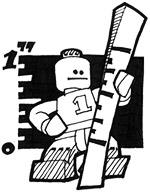
determine a Structure's Size, take your model and measure the
number of inches along the Structural section's longest dimension.
For a wall this would be its length, for a tower this would be its
height, for a sphere you would measure its diameter, and so forth.
Ignore Surface elements when making this measurement, and round fractions
upward or downward according to preference. The number of inches measured
is the Structure's Size rating. To
determine a Structure's Size, take your model and measure the
number of inches along the Structural section's longest dimension.
For a wall this would be its length, for a tower this would be its
height, for a sphere you would measure its diameter, and so forth.
Ignore Surface elements when making this measurement, and round fractions
upward or downward according to preference. The number of inches measured
is the Structure's Size rating.

| The variety of possible
Creatures is limitless, but gauging their relative strength
is as simple as measuring the lengths of their spinal
column and cranium. |
| Elements shown:
LEGO |
|
Vermin
Most Structures have a minimum Size of 1, but for very small Creatures
(snakes, bats, scoprions, and parrots, for instance) a Size rating
of zero is allowed. These tiny zero-Sized Creatures are called Vermin and do not recieve an Armor Level like other Creations. By default,
Vermin have zero points of Armor and a Base Cost of zero CP;
additional Armor can be bought at +0.5CP per +1 Armor.
Structure Level
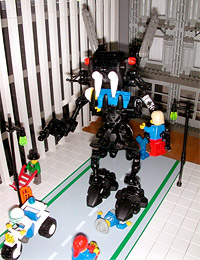
| The Armor Level of Shaun
Sullivan's evil Juggerbunny fluctuates according to how
fast it can absorb live rabbits. Fortunately those little
buggers breed quick. |
Photo: Shaun Sullivan
NELUG's "T.E.A.M. Rebirth," June 2005
Winners: not the civilians |
|
 A
Structure's Armor is determined by its Structure Level.
A Creation's Structure Level is chosen by the player, up to the Creation's Size, according
to what seems most appropriate. A
Structure's Armor is determined by its Structure Level.
A Creation's Structure Level is chosen by the player, up to the Creation's Size, according
to what seems most appropriate.
|
| Structure
Levels |
Structure
Level |
Armor
Rating |
Equivalent
Materials |
Building
example |
Vehicle
example |
Creature
example |
0
|
1d6 |
rope, drywall, plastic, flesh |
tent |
hang glider |
minifig |
| 1 |
1d10 |
wood, sheet metal, steel cables, kevlar |
outhouse |
motorcycle |
troll |
| 2 |
2d10 |
brick, log walls, wrought iron |
brick building |
pirate galleon |
dragon |
| 3 |
3d10 |
concrete, mortared stone, armor plating |
castle |
armored tank |
stone giant |
| 4 |
4d10 |
heavy steel, reinforced concrete,
titanium |
nuclear bunker |
space warship |
steel golem |
5
|
5d10 |
adamantite, force fields |
Illuminati pyramid |
Dungam mobile suit |
Olympian god |
|
While Structure Levels are limited to Creations' own Size numbers or lower, they're otherwise entirely a judgment call on the part of the players. The
Armor of a dragon, for instance, might be anywhere from 1d6 to 3d10
depending on its size, age, and type. Keep in mind that the larger
and more heavily-armored a Structure is, the more it will cost.
Surface Armor
As a rule of thumb, all non-structural Surface Elements, interior walls, weapons,
or devices have a Structure Level one level below that of the main
Structure. Any exposed hinges,
turrets, or other moving parts are considered "weak points"
and are two Structure Levels weaker. Regardless of how low the Structure Level of the main body is, these Surface Elements and weak points can never be reduced to below the minimum Structure Level of 0 and Armor Rating of 1d6.
Incidental decorations and other objects mounted to the Structure
may have higher or lower Armor Ratings as seems appropriate to their particular nature.
Base Cost
 When
the Size and Structure Level have been determined, multiply them
together (for Structure Level zero, multiply Size times 0.5). The
result is the Structure’s Base Cost. A player must pay
this many CP in order to build the
Creation's central Structure. When
the Size and Structure Level have been determined, multiply them
together (for Structure Level zero, multiply Size times 0.5). The
result is the Structure’s Base Cost. A player must pay
this many CP in order to build the
Creation's central Structure.
7.2: Propulsion

| Dave Eaton's magnificent
Post-Apocalyptic Research Vehicle is the target in a running
battle across the nuclear wasteland. |

| Jonathan Dallas's converted
assault schoolbus is loaded with dynamite-strapped kamikaze
warriors and a catapult with which to launch them. |
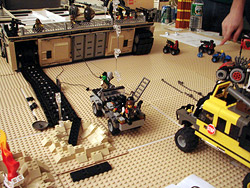
| The massive propulsion
treads prove to be a weak spot - the detonation of one
well-placed kamikaze snaps the tread and leaves it to
trail out behind the PARV until the vehicle grinds to
a halt. |
Photos: Wayne McCaul
NELUG's "The Post-Apocalyptic Research Vehicle,"
Sept. 2005
Winners: Omics (PARV) |
|
 Any
Creation that moves around requires a Propulsion system, even
if the method of that Propulsion is hard to explain (construction-brick
siege engines, for instance, are notorious for rolling around merrily
despite a lack of horses or slaves to pull them). All that’s
important is the Creation's type of movement; whether or not it has
any means to power that movement is politiely overlooked. Any
Creation that moves around requires a Propulsion system, even
if the method of that Propulsion is hard to explain (construction-brick
siege engines, for instance, are notorious for rolling around merrily
despite a lack of horses or slaves to pull them). All that’s
important is the Creation's type of movement; whether or not it has
any means to power that movement is politiely overlooked.
Propulsion Types
Most regular types of Propulsion (Ground, Water, and Underwater) cost 1CP per two
inches of Move (e.g., it costs 5CP to buy 10” of Ground movement). Flying is more expensive:
every two inches of Move cost 2CP plus
the creation’s Structure Level. For instance, an armored space
transport with Structure Level 2 (for 2d10 Armor Rating) would pay
4CP for each 2" of Flight movement.
| Speed
Examples |
| 2" |
spiders, scorpions, hot air balloons,
rowboats |
| 5" |
minifigs, alligators, monkeys, blimps |
| 8" |
tanks, dogs, submarines |
| 10" |
horses, bicycles, boats |
| 12" |
cars, birds, trains, helicopters |
| 16" |
sports cars, planes, motorcycles |
| (upper limit for
regular propulsion types) |
| 20" |
fighter planes, spaceships |
| 24" |
rocket jets, starfighters, superheroes |
| (upper limit for
flight propulsion) |
|
Very advanced or unusual Propulsion types (spider climbing, underground
tunneling, teleportation) may be allowed as well, if the players can
come to mutual agreement about an appropriate CP cost.
Alternate Movement
Creations may sometimes move outside of their usual medium if it’s
appropriate to do so. Common sense should be an adequate guide: automobiles
can move at lower speed through standing water, but they can’t
fly; airplanes can move at lower speed on the runway, but can’t
swim; submarines may move at lower speed on the ocean surface, but
can’t start crawling around on land.
Creations moving in an alternate medium move at half speed. No matter
how much Move they have to spend, no Creation can move more than
five inches in an alternate medium in any single turn.
Propulsion Damage
For most systems, Damage is an all-or-nothing affair: a steering wheel
is either slagged or it isn’t, an elbow is either still attached
or it's not. Propulsion systems are a little more resilient. If attackers
can destroy or disable a major propulsion component (one tire off
a dune buggy, one leg off of a RoboSpider), the vehicle's Move is
reduced by 1" for each lost component. If half of the propulsion
elements are destroyed (one leg off a Tyrannosaurus, one wheel off
a motorcycle) then the vehicle's Move is immediately reduced to 1".
If all the elements are destroyed (one pogo off of a pogo stick, one
balloon off of a balloon), the Vehicle's ability to Move is eliminated
entirely. Flight systems are especially fragile - the destruction
of one blade of a helicopter or one wing of a dragon is enough to
ground them immediately.
7.3: Weapons
BrikWussies (see sidebar) may try to
distract you with talk of the beauty of a Gothic cathedral or the
protective strength of castle walls, but in their hearts the real
BrikWarriors know the truth. The only reason to build the really large
creations is because you need a place to put the really big guns.
| Weapons |
| Weapon |
CP Cost |
Use |
Range |
Damage |
Notes |
| Close Combat Weapons |
| Melee Weapon |
WS x2 |
WS +1 |
CC |
(WS)d6 |
- |
| Ranged Weapons |
| Gun |
WS x3 |
WS +2 |
(WS x3)
+3" |
(WS)d6 |
- |
| Launcher |
WS x3 |
WS x2 |
WS x6" |
(PS)d6 |
max Payload Size (PS)
of WS/2 |
| Explosive |
WS |
* |
* |
(WS)d10 Exp |
* - determined by Launcher |
| Rocket |
WS x2 |
WS x2 |
WS x6" |
(WS)d10 Exp |
- |
| Protection |
| Armor Plate / Shield |
WS |
WS x 2 * |
CC |
(WS)d6 Armor to area;
Shove WS x 2" * |
* - if swingable, may be used
to Parry or Shove |
| Improvised Weapons |
| Bare Limbs |
- |
WS + 2 |
CC |
Shove WS x 2" |
Shove only |
| Random Object |
- |
WS x3 |
CC |
(1/2 WS)*d6 |
* - (1/2 WS) rounded down |
| "WS" refers to Weapon Size, the natural basis for all Weapon stats. |
|
Weapon
Size
As
with Structures and everything else of real importance, Weapons are
classified according to their Size in inches. At a Weapon Size of one inch or less (WS:1), a Weapon is equivalent to what you might find
in the hands of a minifig. However, as Size increases, so do the Weapon's
stats – every statistic is multiplied by or added to Size.
Because Weapon Size increases the Use rating along with the Damage
rating, the highest-damage weapons are most effective against the
largest targets - minifig troops are just too hard to hit with high-Use-rated weapons. Contrarily, high-accuracy small arms are most effective against minifig targets, since their Damage rating isn't high
enough to pose a real threat to larger Creations.
 |
| Weapon
Example: The Ripper Blade |
Example: Cobbling together war machines to defend their swamp and
kin, Bayounix take standard weapons and (BAM!) kick them
up a notch. Thanks to a discarded hacksaw and a wildly
incorrect glasses prescription, a Bayounik man is inspired
to forge a vicious Ripper Blade.
After selecting and measuring the appropriate Bayounikal
element for the blade, the player may choose to make
it anywhere from a Size 3 to a Size 5 Melee Weapon,
according to how he fudges the measurement. He splits
the difference and arbitrarily picks a Weapon Size of
4. Where a standard Hand Weapon has stats of Cost:2
Use:2 Damage:1d6, his Size 4 Melee Weapon now has stats
four times more awesome. It costs 8CP,
has a Use rating of 5, and does 4d6 Damage. |
|
|
Size Limits
Weapon Size is also important because it determines the limit on the number
of Weapons a Creation can have equipped. Every Creation is limited
to equipping twice as many inches’ worth of Weapons as the Creation's
own Size rating (except for Size 0 Creations, which are allowed one inch of Weapons out of pity). Creations flying in the air (rather than in outer
space) are limited even further, to their own Size. If a Creation
has more Weapons than its Size Limit, the Weapons must be 'down-powered'
- the physical Weapon model may be five inches long, for instance,
but only be given stats for Weapon Size 3.
|
| Size
Limit Example: Scorpiosaurus Rex |
Example: With ratings slipping against sleeker, sexier velociraptor
upstarts, Scorpiosaurus Rex is trying to regain popularity
with a bionik makeover.
The Scorpiosaurus Rex is a Size 3 Creature. With a four-inch
Scorpion Tail and two one-inch Claw Blades, it is at its
Size Limit of six inches' worth of Weapons. If its owner
wants to install a Size 1 set of Eye Lasers in its head,
the Scorpiosaurus will have to either lose one Claw Blade
or downgrade its Scorpion Tail to Size 3 stats, in order
to stay within its six inch limit. |
|
|
Weapon
Types
The functions of most Weapon types are easy to scale upwards with Size; they're just like their minifig versions, but with larger numbers attached. There is one exception: Explosives, whose blast radius increases with Size upgrades, as well as two new categories: Launchers, whose Damage and effects are dependent on their payload, and Rockets, which are simply self-launching Explosives.
Heavy Explosives
When a minifig Explosive goes off, the blast damages all objects within two inches. With larger Explosions, this radius is multiplied, doing the greatest Damage at the center and diminishing over distance. Both Explosives and Rockets do Explosion Damage (Exp). Explosives must be dropped, thrown, or launched out of a Launcher, while Rockets may be fired off like a single-use Ranged Weapon.
When an Explosion occurs, the player rolls the number of d10s in the weapon's Damage rating and leaves the dice on the table. All objects within a two-inch radius of the blast center take this much damage, and any loose objects in this radius are Knocked Back one inch for every die in the roll (Chapter 5.4: Charge! ).
For a 1d10 Explosion, this is all that's required. For a multiple-d10 Explosion, after handling Damage for all the objects within the first two inches, remove the lowest die in the roll, and count the new total result on the dice that remain. All objects within the next two inches of radius take this new result in damage, and loose objects are Knocked Back a number of inches according to the number of dice remaining. Continue removing one die for every two inches and distributing damage and KnockBack accordingly, until no dice remain in the Explosion Damage.
Players may wish to save handling all KnockBack effects for the end, in order to avoid accidentally damaging the same object twice.
Payload Launchers
The Launcher category covers any device designed to launch a Payload across a distance, from minifig-scale bazookas, mortars, and slingshots to siege-scale catapults, trebuchets, and artillery cannons. Launchers are ideally used to deliver Explosive Payloads, but boulders and debris raining onto enemy formations have also always had their own special charm.
Unlike regular types of Ranged Weapons, for which ammunition is mysteriously never an issue, a Launcher's Payload must always be represented in-game by a physical object. All Launchers must have a designated area for loading their Payload (e.g., the basket of a catapult, the breech of a cannon, or the trolley of a railgun), and all Payloads must be placed into or onto this location prior to Launch. Players may choose to construct their Launcher with an ammunition battery for auto-loading (such as a missile rack or ammunition drum), but most Launchers end up being loaded by minifigs carrying objects by hand. Less traditional Payloads are possible and fully encouraged; a Launcher might also be used to scramble spacefighters or deliver paratroopers, for instance. As long as it is properly loaded, a Launcher may fire one Payload per turn.
A Launcher can fire any object up to one half its own Weapon Size, rounded down (This means that a Size 1 Launcher can only launch Size 0 objects, such as minifig equipment or Vermin). A launched Explosive uses its Explosion Damage rating on impact. Non-Explosive Payloads do Crash Damage with full Momentum (7.6: Creation Combat), doing a d6 of Damage for each point in their current Structure Level ((PS)d6 Crash Damage). (If it's important, Payloads take the appropriate amount of Crash Damage in return from whatever objects they Crash into.)
Launchers fire their projectiles in parabolic arcs rather than straight lines. This means that a Launcher can fire over the tops of obstacles to strike targets behind them (subject to a possible -5 Attack Penalty for firing at targets they can't see (5.1: Making Attacks)), and that, unless the attacker specifies otherwise, the Payload will fall on its target from above rather than along the Launcher's line of sight. It also means that a Missed Shot with a Launcher always has to come down somewhere, unlike regular Missed Shots which can fly off harmlessly into the sky and be ignored (5.3: Ranged Combat), and because Launchers are notoriously inaccurate, this will happen fairly often.
As they get into larger Sizes, Launchers have much longer range capabilities than other types of weapons. A large Launcher can fire so far, in fact, that the projectile doesn't come down until the following turn, giving potential targets a chance to scatter. Any time a Launcher fires at a target more than twelve inches away, the Payload is launched, but the attacker doesn't immediately make his Attack Roll. Instead, he places a marker at the intended target (an "X" built from red bricks is traditional), and makes the Attack Roll when the Payload strikes on the beginning of his following turn, to see whether the projectile missed and by how much.
7.4: Taking Action

| If a Creature is clearly
Half-Minded but doesn't fit into one of the standard categories,
players can make up rules ad hoc for whatever its bizarre
impairments may be. |
Elements shown:
Sullis, doughnut
Photo Credit: Todd Lehman |
|
 Not
all Creations are designed for active roles. Objects like trees, warehouses,
and bridges perform their duties perfectly well by just sitting there
and not wandering off at critical moments. If a Creation is intended
for more active tasks, such as moving around, carrying loads, or vaporizing
civilians, it will need to have either a Mind of its own, or
intelligent Operators at the controls. Not
all Creations are designed for active roles. Objects like trees, warehouses,
and bridges perform their duties perfectly well by just sitting there
and not wandering off at critical moments. If a Creation is intended
for more active tasks, such as moving around, carrying loads, or vaporizing
civilians, it will need to have either a Mind of its own, or
intelligent Operators at the controls.

| Some Minds are more
intelligent than others. |
|
Minds
The difference between a Creature and a Vehicle is that a Creature
is capable of independent thought and action, whether its brain is
composed of meat, circuitry, or magic. If a giant mech requires a
minifig to pilot it, then it's a Vehicle; if it can operate independently,
it's a Creature.
Giving life to a Creation is cheap and easy. For a CP cost (minimum 1CP) equal to the Creation's
Size, it develops a Mind, becoming a full-fledged Creature with a Skill of 1d6. Additional Skill boosts of +1 Skill level (or +1 die size, if players have the appropriate dice) can be purchased
for the same price.
| Skill Levels |
| Level |
Skill
(standard) |
Skill*
(fancy) |
Description |
Example |
| 1/2 |
1d6-2** |
1d4* ** |
Incompetent |
(see Half Minds, below) |
| 1 |
1d6 |
1d6 |
Trained (default) |
standard troopers |
| 2 |
1d6+1 |
1d8* |
Expert |
specialists, officers, veterans |
| 3 |
1d10 |
1d10 |
Heroic |
Heroes |
| 4 |
1d10+1 |
1d12* |
Supernatural |
demigods, immortals |
* - Although BrikWars' Core Rules are designed to rely on d6es and d10s as much as possible, if you also have d4s, d8s, and d12s handy, it's good form to use them instead when their associated Skill levels call for them.
** - Incompetent creatures never get Bonus Dice on their Skill rolls. |

A d4, d6, d8, d10, and d12, respectively.
If you've read this far, you almost certainly already have some of these. |
| Elements shown: dice |
|
Creatures with Minds have the same mental abilities as regular minifigs.
As long as they have the proper appendages, they can use equipment,
open doors, and toss items around as normal. Common sense should be
an adequate guide for whether a Creature has the proper body shape
to work a stick shift, or the fine manipulators to type on a keyboard.
In the occasional instances in which players aren't sure, a What I
Say Goes roll can quickly resolve the issue with an ad hoc edict or
special rules (for instance, an intelligent cockroach can type on
a keyboard by jumping real hard, but it takes him twice as long as
normal, and he can't use the shift key without the help of a friendly
cat).
Half Minds
|
| “Wild animals never kill
for sport. Man is the only one to whom the torture
and death of his fellow creatures is amusing in
itself.” |
| - James Anthony Froude |
|
|
|
Creatures with Minds are fully independent, able to form their own
strategies and wage effective warfare without supervision. If this
doesn’t fit your vision for the Creature, you may elect instead
to give it a Half Mind, at one half the cost of a regular Mind.
+1 Skill boosts can still be purchased at the full regular price.
|
 |
An Incompetent Creature is similar to other full-Minded
Creatures, but due to a lack of training, skill, or intelligence,
it is prevented it from being an effective combatant.
An Incompetent Creature’s Skill is set at 1d6-2 (or 1d4, if you have d4s handy) and
cannot be raised any further with Skill boosts or Bonus Dice.
Examples: Zombies, civilians,
zombified civilians, Republicans, corporate middle managers,
clone-brand minifigs, ogres, mutants, Democrats |
|
|
|
 |
A Simple Creature is limited in its ability to
make complex strategic decisions, and instead follows
a simple set of behaviors. Simple Creatures are given
a list of behaviors at the beginning of the battle, and
may only behave in accordance with those instructions.
A Simple behavior must be fairly specific: “Move
to the nearest wounded allies and attempt to heal them”
or “Stay close to allied troops and fire at enemy
combatants” would be fine behaviors; “Defeat
all enemies” and “Win the battle” would
not. Random animals and wildlife are often made Simple for efficiency’s
sake, with short behaviors like “flee from any nearby
threat” or “if it's nearby and looks edible,
try to eat it.” While not technically Creatures,
traps and mechanized defense systems are often given Simple behaviors as well, for instance
"fire at anything in range and moving" or "if
the pressure plate is activated, release poison gas."
Examples: Kill-bots, golems,
summoned elementals, guard dogs, mind-control victims,
AOL users, sheep |
|
|
|
 |
A Submissive Creature may have a limited ability
to think on its own, but prefers to obey the commands
of a master. Under an intelligent minifig’s direction,
the Creature may act as intelligently as if it had a full
Mind, but if abandoned, the Creature reverts to whatever
animal-like behavior seems appropriate: milling around
aimlessly, running and hiding, or attacking everything
in sight. If another intelligent minifig can catch a masterless
Creature, regardless of whether he’s on the same
team, the Creature accepts him as its new master.
Examples: Steeds, androids,
grad students, interns, housepets, work animals, targeting
computers, football players, fetishists, cultists |
|
|
|
 |
Subjugated Creatures are restrained or harnessed
somehow and forced to cooperate against their will. They
may in fact be completely intelligent, but have Half a
Mind to break free and run amuck. As long as they are
kept in their restraints, they must follow the orders
of their captors, but if they can be released, they will do
whatever they can to prevent being enslaved again. This
usually means attacking their captors or fleeing the battlefield,
but can also be as simple as just attacking everything
in sight, regardless of allegiance.
Examples: galley slaves,
schoolchildren, chain gangs, draft oxen, conscripts,
berzerkers, retail employees |
|
|
|
| Half-Mind
Example: The Horse |
Example: Horses (Chapter H: The Horse) are Submissive Creatures with the following stats:
SIZE: 2
ARMOR: 1d6 (Structure Level
0 x Size 2 = +1 CP)
MOVE: 10" (2"
x 5 = +5 CP)
SKILL: 1d6, submissive
(Size 2 x Half Mind = +1 CP)
WEAPON: Kick or Bite CC
UR2 1d6 (Size 1 Melee = +2 CP)
COST: 9 CP
This WarHorse's plate mail costs +1 CP and upgrades its Armor to 1d10. |
|

|
|
Enhanced Abilities
As with minifigs, a Creature with a standard Mind has one Action
per turn and can attack with one ranged weapon or two melee weapons.
If that's not enough for the species you have in mind, you can purchase
additional levels of capacity for the cost of the Creature's original
Mind. There are two types of mental capacity:
|
 |
Multidexterity
Appropriate for Creatures with multiple arms or several
natural weapons, Multidexterity increases the number
of weapons the Creature can use in a single attack, provided
it has enough hands to use them. In a given turn, Multidexterity allows the Creature to attack
and Counter with two additional Close Combat weapons,
use one additional weapon in a Ranged attack, or use one
additional set of tools for other special actions. The
Creature is still limited to taking Action against a single target
during its turn, unless it has also purchased the Multitasking
ability. |
|
|
|
|
Multitasking
Appropriate for Creatures with multiple heads or an advanced
multiprocessing brain, Multitasking (or "Extra
Action") allows a Creature to focus on one additional
target during its turn. A Creature with multiple Ranged
or Close Combat attacks may divide them between multiple
targets in the same turn. A multi-brained or superintelligent
Creature can even take two or more completely dissimilar
Actions in the same turn (e.g., playing the piano while
laying down sniper fire); however, it may not use the
same weapon, hand, or equipment item for more than one
Action during the turn. It may not use more than two hands
or weapons for Actions unless it has also purchased Multidexterity. |
|
|
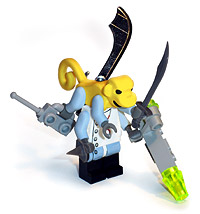
| Elements shown:
LEGO, Little Armory |
|
|
| Enhanced
Abilites Example: Professor Monkeyhead |
Example: A pioneer in the field self-bioengineering, the six-armed
Professor Monkeyhead is brilliant but insane.
Once a normal minifig (4CP), the Professor has spent a
further +2CP to raise his Skill to 1d6+2, +2CP on Multitasking
to engage in three Actions at once, and +1CP on Multidexterity
to use any four of his six hands at the same time. His
total worth is now 9CP, enough to apply for tenure in
his university department. |
|
|
Operators
Any Creation can be loaded up with systems and abilities, but
if it lacks the intelligence to use them then it’ll need an Operator to take control.
Controls
Ideally, controllable Creations should include some type of Control Element (a steering wheel, a flight stick, a computer console), but if not,
they should at least have a specified Control Area where a
minifig has to position himself if he wants to act as an Operator. Different types
of Controls may be able to control the entire Creation (a vehicle’s
cockpit, a building’s nerve center, a space station’s bridge,
a horse’s saddle), or simply a single system or function (a gunner’s
chair, a ship’s wheel, a missile silo's Big Red Button).
Enemy minifigs can cripple a Creation by destroying its Controls.
But better still, they can kill the Operators and commandeer the Controls
directly. (Plastic-brick Control systems lack security precautions
like passwords or ignition keys.) If more than one team has minifigs
in a Control area at the same time, they can each use their Actions
to prevent the other from Operating the Creation at all.
In the rare case that minifigs from allied teams find themselves at
the same set of Controls, they cannot each Operate the Creation on
their own turns – that would effectively double the Creation’s
abilities unfairly. A team can only Operate a system if none of its
allies used the same system on the allies' previous turn. This special
limitation only applies to allies. When enemies commandeer a set of
Controls, they can make full and immediate use of them, justified by the fact
that it’s much funnier to let them have instant benefits than
to give the original owners any time to react.
Systems
Assuming he has access to the proper Controls, an Operator
can use its Action to control one (and only one) System on
a Creation, against a single target. This may be any one of the following:
|
|
Propulsion: driving the vehicle – any combination
of steering, accelerating, decelerating, etc. Charge attacks
are allowed as part of Propulsion (5.4:
Charge!). |
|
|
|
|
Ranged Weapons: firing a single weapon, or a
paired set of identical weapons, at a single target (5.3: Ranged
Combat). |
|
|
|
|
Melee Weapons: using one or two melee weapons in Close Combat against a single target (5.2:
Close Combat). |
|
|
|
|
Manipulators: lifting, carrying, throwing, dropping,
or otherwise manipulating one object or grouped set of
objects. |
|
|
|
|
Devices: activating, deactivating, or otherwise
controlling one special-purpose device, such as sensors,
shields, transporters, a cloaking device, or a self-destruct
function. |
|
|
If no Operator is actively controlling a System, it continues doing
whatever it is doing – shields stay up, sails stay unfurled,
robotic hands maintain their bloody grip on crushed enemy heads. This
is most frequently a factor when steering Vehicles. If the driver
of a moving Vehicle switches his attention to firing weapons or operating
other devices, the Vehicle continues moving in its current direction,
at whatever speed it was traveling at the end of its last turn.
The Pilot
Any minifig can drive a Vehicle or direct a steed, but if they try
to do anything else at the same time (applying makeup, talking on
a cell phone, targeting enemy airfields with roof-mounted artillery
pieces, etc.), then disaster is almost guaranteed. Steering a Creation
and operating its weapons or devices are separate Actions, and a regular
minifig can only do one or the other in any given turn. Armed Vehicles
will often have separate minifigs acting as drivers and gunners; if
the driver of a moving vehicle switches to gunning or some other task,
the vehicle continues moving in a straight line at its current speed
until the minifig returns his attention to driving.
The exception to this rule is the specially-trained Pilot,
who can steer and take a regular Action at the same time. Pilots will
usually use this ability to make attacks: a helicopter Pilot might
fly in and open up with machine guns, a gangsta Pilot might perform
a drive-by spraying handgun rounds out the window, and a horse-mounted
Rider might charge past and cave in your skull with a spiked mace.
Less belligerent Actions are just as easy, although less destructive:
a starship Pilot might use his mid-maneuver Action to recalibrate
shields, warm up a cloaking device, or activate the passenger compartment
ejection system.
7.5 Taking Damage
|
| “All created things are
impermanent.” |
| - Buddha |
|
|
|
For minifigs and other small Creations (Size 1 or less), injuries
are simple to deal with. Damage higher than their Armor rating kills
them; Damage of an equal or lesser amount has no effect.
A larger Creation takes a little more work. Overcoming its Armor rating
doesn’t grant an instant kill. Depending on how large the Creation
is, the Damage might only weaken it by stages or break off chunks
of individual bricks.
When attacking a large Creation, players can handle the Damage in
two ways. General Damage weakens a target Creation's overall
abilities and wears it down by attrition. Component Damage lets attackers focus on destroying individual systems or construction
elements.
General Damage
Targeting a Creation for General Damage doesn't take
a lot of precision – the attacker just has to be able to target
any part of the Creation’s central Structure (7.1:Structure).
This will often grant a nice bonus to the Attack Roll, since the attacker
can take a Size bonus for however much of the Structure is visible
to him (+1 bonus per 2” target Size; see 5.1: Making Attacks). If the attack strikes
Surface rather than Structural elements of the Creation, it damages
the Surface elements specifically rather than doing General Damage (see Component Damage, below).
Size Damage
As when attacking minifigs, General Damage must first exceed the target’s
Armor to have any effect. If it does, the target Creation takes one
point of Size Damage, represented by sticking a colored Damage
Pip to a prominent spot on the Creation or its baseplate. Black
or red 1x1 bricks are the usual choice for Damage Pips, although other
elements may be used for convenience or better visibility.
When a Creation takes a point of Size Damage, its Move is decreased
by 1" (to a minimum of 1") and its abilities are reduced
as if its Size were one inch worse. The weapons and devices it can
activate during a turn, as well as the Creation's maximum Momentum in a Charge
attack, are decreased as if it were one inch smaller. The Creation's Structure Level is decreased to match the new effective Size limit, if necessary, making damaged Creations that much more vulnerable.
If Size Damage is enough to reduce a Creation's effective Size
to zero, the Creation is destroyed in the manner that seems most appropriate.
Towers collapse, spaceships explode, whales go belly-up, zeppelins
burst into flame, and pirate ships sink to the briny bottom. Creations
of Size 1" (and Vermin of Size 0") are destroyed on the
first point of Size Damage.

| Never having been known
for its sense of fair play, this Mega Bloks dragon aims
for a particular weak spot while making a bite attack
on its LEGO counterpart. Finer points of reptilian anatomy
aside, it wouldn't be unreasonable for players to grant
this attack a couple extra dice of damage or some especially
crippling side effect. |
| Elements shown:
LEGO, Mega Bloks |
|
Component Damage
When an attacker wants to focus damage on a Creation’s
particular weak point, he may single out an individual construction
element for Component
Damage. This takes a little more accuracy than a General attack
- many elements are small enough to incur Attack Penalties for size,
although a rare few are large enough to confer a bonus (5.1:
Making Attacks). The advantage of Component Damage is
that the targeted sections will often have much lower Armor ratings
than the Creation’s main Structure – one Structure Level
lower (minimum Structure Level zero) for Surface elements and exposed
hinges, and possibly lower still for other decorative features.
If the Component Damage exceeds the target Component's Armor rating,
then the Component is chopped, smashed, or blasted off of the Creation
as seems appropriate. The attacker removes either a single building
element or a chunk of bricks up to 1” in Size. Where possible,
players should try to make the damage appropriate to the attack
type – piercing armor plating with an energy blade makes a
much smaller hole than pounding it with mortar fire. Explosives are especially satisfying when used for Component Damage, as they can potentially destroy a large number of Components in their blast radius at once.
If a Creation is made up primarily of a single large element, such as a towering Cthuloid Furry Horror made out of a stuffed teddy bear, it's
poor form to try and use Component Damage to try and destroy the
whole thing in one hit. Use General Damage, or choose a specific
feature to disable rather than destroying the whole element.
Applications
The precision of a Component Damage attack allows for several
possible applications. A tank's armor, a castle wall, and a dragon's
ribcage can all be breached to expose the juicy innards to more
effective follow-up attacks. Critical devices like steering wheels,
helicopter blades, and kneecaps can be targeted and disabled individually.
By targeting narrow connection points (the tail section of a helicopter
or the waist of a giant wasp), a successful Component Damage attack
can divide one large Creation into two or more small ones. The Size
Ratings of the new smaller Creations are reduced to reflect their
new stature, but each inherits the full Size Damage of the original
Creation, which may mean that one or both are instantly destroyed.
Each section may use whichever weapons and devices remain attached
to it, but only if it has the necessary remaining Size rating and
controls to activate them.

| Overkill allows attacks to punch through a target and keep right on going. |

| Eric Joslin's giant
slays a series of Greg's minifig troops with a single
mighty swing of his flail. |
Photo: Eric Joslin
"NELUG Gets Medieval," Nov. 2000
Winners: a flock of sheep |
|
Special Damage
When the Damage from an attack is much higher or much lower
than the target's Armor rating, players may decide to use special
forms of Damage to account for the effects. Special Damage takes a little more work than the usual kinds and should be saved
for appropriately special occasions.
Grinding
Given enough time, a woodcutter's axe can chop down a redwood, a battering
ram can beat down reinforced gates, and a hammer and chisel can punch
a leak in the hull of a submarine. When the Armor of a target is too
great to ever be overcome in a single attack, Grinding Damage can be used to grind down the Armor statistic over the course of several
turns.
Grinding is different from a regular attack, and a player must declare
that he is Grinding before rolling for Damage. Rather than comparing
the Damage total to the target's Armor rating, he compares the result
on each individual Damage die to the target's Structure Level (e.g.,
a target with Armor rating 4d10 has an Structure Level of 4 (7.1:
Structure)). For each die that comes up greater than the
Structure Level, the target receives one point of Grinding Damage
(use Damage Pips to keep track of this if necessary). The Grinding Damage
is added to the Damage of all future attacks against that target.
Grinding can be used in either a General or Component attack.
The weakened Armor rating only applies to future attacks of the same
type against the same target or component.
Overkill
Normally, attack Damage in excess of a target's Armor rating
is ignored. If an attack is so powerful that players think that even the excess Damage would be enough to overcome
the target's Armor, then that excess amount can be treated
as Overkill Damage. Especially powerful attacks may cause enough Overkill Damage to inflict
multiple points of Size Damage or destroy several Components all at
once.
When an attacker makes a successful attack and decides to go for Overkill, he keeps track of his total Damage and the defender's unsuccessful Armor Roll against it. After applying the General or Component Damage destruction from the initial attack, he then subtracts the result of the first Armor Roll from the Damage. The new total becomes Overkill Damage, and the defender must make a new Armor Roll against it (with the target's newly diminished Armor, if the previous Damage reduced the object's Structure Level) to see if the target takes another point of Size Damage or loses another Component. If the Damage is high enough, there might even be another round of
Overkill from the Overkill. The process may repeat until there is
either no more Overkill Damage or the target is destroyed.
Besides doing multiple Damage levels to a single large target, Overkill
can also be used to blast through a group of smaller ones. Normally, Overkill Damage
is applied to the same target (or a different part of the same target)
as the original Damage. But if the target is broken through, blasted
aside, or destroyed, then the Overkill continues on in the direction
of the attack, striking whatever new targets fall along its path. The Overkill is limited to only those targets within the attack path - a battleaxe is limited by the maximum
reach of its swing, a laser blast by its maximum linear range, and
a Charging bull by the maximum distance it's able to run in a straight
line.
7.6 Creation Combat
In combat, Creations follow the usual attack sequence, choosing between
Ranged, Close Combat, or Charge attacks, making Attack Rolls against
their weapons’ Use ratings, and rolling for Damage against their
targets’ Armor.
Depending on its Mind, a Creature might do all of this as independently
as any minifig. If a Creation lacks a Skill rating of its own, it
will need a minifig or other intelligent Operator at the controls (7.4: Taking Action) whose Skill rating can be used instead. If a Creature has both a Mind
and an Operator, then the Operator gives the commands but the Creature
uses its own Skill Rating when making attacks.
Close Combat
(see 5.2: Close Combat)
A Creation with a Close Combat weapon can use it to whack at targets
the same way a minifig might. However, Creations are not always able
to participate fully in the back-and-forth attacks of formal Close
Combat. There are specific conditions under which Creations may have
their abilities limited.
|
|
Mindless: Unlike independent Creatures, a Creation
being piloted by a normal Operator lacks the necessary reflexes
to Counter attacks, unless the Operator has the Piloting Specialty. |
|
|
|
|
Too Big: Larger combatants lack the reflexes
to Counter against opponents much smaller than themselves.
A Creature or Pilot-operated Creation can Counter against an opponent with half its
Size rating, but no smaller. Only a Size 0 Creature can
Counter against another Size 0 Creature. |
|
|
|
|
Too Small: Creations can only Shove targets their own Size or smaller. Creations can only Shove objects larger than themselves by teaming up, adding their Sizes together in a Combined Attack. |
|
|
|
|
Unmoving: Creations without some kind of leaping ability
cannot use an Angry Inch when making their attack. |
|
|
For rules on how to handle Close Combat attacks from individual Operators or other passengers while riding a Creation, see H.3: Fighting From Horseback.
Ranged Combat
(see 5.3: Ranged Combat)
Minifigs are able to change facing instantly and swing their arms
to point weapons in any direction. Depending on their type of Propulsion
system and the way their weapons are mounted, some Creations may
be much less flexible.
To make a Ranged attack, a Creation must be able to point its weapon
at its target. The aiming doesn't have to be perfect, however - players
are allowed to fudge the angle by up to forty-five degrees. Both the
firing angle and the weapon Range are measured from the end of the
weapon barrel. (Building a telescoping barrel to take advantage of
this fact is perfectly legal as well as being symbolically satisfying.)
Players can mount a Creation's weapons on any type of turret, hinge,
or arm to cover a wider firing arc. This has no extra cost, but remember
that any moving parts involved are automatically at two Structure
Levels lower than the rest of the Creation (7.1:
Structure: Structure Level).

| Charge attacks are not
always on purpose. The Charging rules also apply to minifigs
that unsuspectingly run headlong into sharpened-stake
booby traps, or locomotives encountering abandoned laundry
machines. |
| Elements shown:
LEGO, string |
|
Charge Attacks
(see 5.4: Charge!)
The best thing about big things is smashing them into other things. For many plastic-brick fans, this is the first use to which they ever put their creations, and for some it's all the game they'll ever need. BrikWars salutes the human spirit and its basic need to smash.
The power and effects of a Charge depend on the Size and Structure Level of the colliding objects. The rules for handling Charges have been presented in limited form twice in previous chapters, for two specific object Sizes: The rules given for minifigs (5.4: Charge!) are the rules for objects of Size 1", while the rules given for Horses (H.3: Fighting From Horseback) are the rules for objects of Size 2". The Charge rules presented here are the generalized rules for all Sizes of objects.
Momentum
MOM = 1d6 per 2" of Charge, maximum (Size)d6
Charge attacks become much more satisfying as the colliding objects get bigger, but they also become more complicated. Where a Size 1 minifig can build up 1d6 worth of Momentum with a Charge of two inches (5.4: Charge!), and a Size 2 Horse can build up 2d6 worth of Momentum in a Charge of four inches (H.3: Fighting From Horseback), larger Creations are able to build up correspondingly greater Momentum as they extend the length of their Charge.
A Creation builds up 1d6 of Momentum (MOM) for every two inches in its Charge, up to a maximum number of dice equal to its own Size. These MOM dice can be added to the Damage from an attack with a Charging Weapon or to the inches from a successful Shove, and they are also used as the Creation's KnockBack Roll in a collision.
Even while Sprinting, a very large Creation may not have enough Move to build up to its full Momentum in a single turn. Fortunately, Creations can extend a Charge over multiple turns to travel the distance required. Extended Charges are best used against inanimate targets like walls and security gates, as more mobile targets can casually walk off of the line of a Charge between turns and sidestep the attack entirely.
|
| MOM Example: Don Coyote and the Fire Giant |
Example: The biker Don Coyote tilts his lance
at a rampaging Fire Giant. The Fire Giant, unfazed, Charges straight back at Don Coyote. With multiple turns and plenty of space to accelerate, each builds up his full Momentum according to Size - MOM:2d6 for Don Coyote after his first 4", and MOM:4d6 for the Giant after his first 8".
The Fire Giant has no interest in wasting time with tiny bikers, so he winds up for a giant windmill kick to launch Don Coyote back to the middle ages. His Giant leg is much longer than the biker's lance, so he would normally get to strike first, but since Don Coyote is attacking the leg itself, both attacks end up connecting simultanously.
The Giant has a Size of 4, but since Don Coyote is attacking the leg specifically, he only gets the Target Size Attack Bonus from the Size of the leg itself.
A quick measurement shows that the Giant's shin is 2" in Size, giving Don Coyote a +1 to hit. Even with the bonus, his roll of 2 is not enough to meet his lance's Use Rating of 4; he misses the incoming leg.
The players rule that the Giant's leg counts as a Size 3 Bare Limb, giving it stats of Use:5 and Shove:6". The Giant has a Skill of 1d6, and rolls a 6 for the Attack Roll - no need to roll the Bonus Die, the Giant has nailed the punt. Don Coyote and his bike are launched far into the distance: 6" directly backwards, plus another 4d6" from the Giant's Momentum bonus.
Because Bare Limbs do Shove effects only, Don Coyote takes no damage from the kick itself. Depending on the launch angle the players agree on, he may take Falling Damage when he reaches the end of his trajectory and falls from the sky, he may take Smash Damage if he crashes into any obstacles along the way, and at minimum he will certainly take one point of Trample Damage when his motorcycle lands on top of him. |
|
|
Crashing
Damage = Structure Level x d6, limited to 1d6 per 2" of Charge
It's nice to channel the power of a Charge into a Charging Weapon attack, but units don't always have a Charging Weapon handy, and even when they do, they sometimes miss. Momentum's potential for destruction is most directly expressed in the form of two objects simply smashing into each other, and that is awesome. When two objects collide, each does Crash Damage to the other based on their total combined Charge distance, regardless of whether one or both were moving at the time of collision.
The amount of Damage caused by colliding objects is determined by their Structure Level and by the length of the Charge. An object delivers 1d6 of Crash Damage for each point in its Structure Level, limited to 1d6 per two inches Charged. Only the object's basic Structure Level (including penalties from Size Damage, if necessary) counts towards this total; simple Armor boosts from equipment modifications like Body Armor or Shields are not considered.
No Skill Roll is required for a unit to smash itself into something. Unless the target manages to Bail out of the way (4.3: Enemy Response), success is automatic. Units with Shields can use them to Parry Crash Damage as if it were a regular Close Combat Attack.
In the case of an Unintentional Collision, such as for out-of-control vehicles, minifigs running into invisible walls, or objects falling from great heights, it's up to the players to determine the Charge distance by estimating how much straight-line distance the objects traveled. Only the turn immediately prior to the impact need be considered; objects don't unintentionally make Extended Charges. (However, players should be generous in overlooking slight curves in the path of an Unintentional Collision, since Unintentional Damage is much funnier than the regular kind.) As a rule, all of a falling object's travel is counted as being in a straight line; players are expected to forget they know anything about parabolas for the purpose of maximizing Collision Damage from falls (see "Falling Damage" sidebar).
KnockBack
KnockBack = (MOM - POP)"
POP = (Size)d6
As colliding objects get larger, they can dish out and absorb much greater amounts of KnockBack, leading to hilarious results and new distance records when very large objects slam into very small ones.
To make the KnockBack Roll, the Charging unit rolls its Momentum (MOM) against the Physical Opposition (POP) of the object it's crashing into. MOM is determined by the Charging unit's Size and the distance of the Charge, as described above; POP is determined solely by the Size of the object being struck, with no consideration of Charge distance. All objects have 1d6 of Physical Opposition for every point of Size (making sure to consider penalties for Size Damage (7.5:Taking Damage)), or POP:(Size)d6.
If the POP roll is equal to or greater than the MOM roll, then no KnockBack occurs; both objects are brought to a halt, and are immediately entered into Close Combat if applicable. If the MOM roll is larger, then the struck object is Knocked Back a number of inches equal to the amount by which the MOM beat the POP, or (MOM - POP)".
The winning player applies these inches of KnockBack to the loser's model at the point of contact. He might decide to be kind and move the Knocked-Back
unit away from the impact in a simple horizontal line, but that’s
pretty unlikely. He’ll get a much bigger kick out of tossing
his victim up into the air or spinning it around, pivoting the model around an opposite corner or edge. If the loser's model pivots enough to roll onto its side or upside-down, then it's Knocked Over and Disrupted, unable to take any Action or defend iself until it gets itself back upright. For vehicles, it's even worse: Knocked Over boats
are capsized and sink at the end of their following turn; flying vehicles
tend to crash.
If the two objects are Charging at each other simultaneously when they collide, they'll each need to make a KnockBack roll against the other. Fortunately these can be combined. In most cases, the MOM and POP rolls for a Charging unit will be the same number of dice; a single die roll will serve for both of them. In situations where a unit fails to Charge far enough to build up full Momentum, his MOM roll will have fewer dice than his POP. In this case, make the POP roll as usual, and from that roll, pick out the highest-rolling dice (along with their associated Bonus Dice, if applicable) in the proper number to serve as the MOM roll.
|
Some may question selecting the highest rather than the lowest dice in a head-on collision - wouldn't a Charging unit be more difficult to Knock Back, rather than easier? Rather than wasting thought on consideration of logic or realism, consider this: which is better for chaos and destruction, more KnockBack, or less? That should end all debate. If not, say "it's a higher energy collision, so of course there'd be more KnockBack" and hope no one calls your bluff. |
|
Smashing and Trampling
If an object can't be Knocked Back the full distance, either because its trajectory is blocked by an obstacle at least half its Size (smaller obstacles are simply Knocked Back as well) or because it is "tied down" (like a castle wall, palm tree, or Statue of Liberty),
then both it and the obstacle take one point of Smash Damage for each inch of KnockBack that's prevented. If this Damage is enough to break a tied-down object from its foundation, or enough to Smash through the blocking obstacle, then the remaining points of Smash Damage are converted back into KnockBack inches and the object keeps right on going.
If a Knocked Back object is Disrupted and falls in the path of a larger Charging attacker, it may take additional damage if the attacker has enough Move left to Trample over it that turn. A Trampling attacker does Trample Damage according to how much larger it is than its victim - one point of Trample Damage for each inch by which its Size exceeds the Size of the victim (Attacker Size - Victim Size), taking Size Damage into account for each of them.
Smash and Trample Damage are cumulative with all other damage from the Charge.
|
| KnockBack and Trample
Example: Crocodile Surprise |

| With two
inches of Knockback to play with, there are a number of trajectories on which this Crocodile
Knight can send the Frog Peasant. Naturally, he chooses one that knocks the Peasant off his feet. |
| Elements
shown: LEGO |
|
Example: A Frog Peasant is spending a peaceful
swamp afternoon foraging for escargot. Little does he
expect that a marauding Crocodile Knight is about to
burst from the water in a Charging ambush!
Because of the difficult swamp terrain, the Crocodile
Knight is only able to line up three inches of straight-line
Movement for his Charge. This gives a Collision Speed
of 3", for one die of potential Momentum. This
is less than the Crocodile Knight's Size of 2, so his Momentum is MOM:1d6.
Facing in the wrong direction, the Frog Peasant doesn't
see the attack coming, and so he has no chance to Bail or even make the reflexive Surrender
for which the Frog people are famous. His Physical Opposition is determined by his Size of 1, so is Physical Opposition is POP:1d6.
The Crocodile Knight's Halberd is pointy enough to count as a Charging Weapon, and so it's eligible for the +1d6 Damage Bonus from Momentum. Although the Crocodile Knight successfully makes his
Attack Roll with the Halberd (Use:4), his Damage Roll comes
up 1, 2, and 1 (Weapon Damage: 2d6 plus Momentum:
1d6) and the Frog Peasant manages to miraculously survive
the initial Damage (4 Damage vs. 4 Armor; Peasant survives).
KnockBack isn't a foregone conclusion, since the Knight's short Charge distance prevented him from building up full Momentum. The Knight
rolls his MOM die (1d6) against the Peasant's POP (1d6).
Luckily, his roll of five, minus the Peasant's roll of three, results in two inches of
KnockBack with which to toss the Peasant around however
he sees fit. The Knight chooses a spin that knocks the Frog off his feet and Disrupts him, landing two inches away and well within the remaining inches in the Knight's Charge. His Crocodile races forward to stomp the helpless Peasant into the mud, doing an additional point of damage (Knight's Size of 2 - Peasant's Size of 1 = 1 point of Trample Damage), which is enough to kill the Frog once and for all (4 Damage + 1 Trample Damage = 5 Damage vs. 4 Armor; Peasant is Trampled to death). |
|
|
Plow Through
With enough Momentum, a Charging Creation can use KnockBack to knock multiple loose objects out of its path and keep right on going. The ability to Plow Through multiple targets is like a form of Overkill (7.5:
Taking Damage) that's based on Momentum rather than Damage.
When a Charging attacker hopes to Plow Through a series of objects, he handles the first collision as usual. If he's successful in knocking the first target out of his path in order to continue his Charge, then he keeps track of the number of inches of KnockBack resulting from the KnockBack Roll. This number becomes his Plow Through Momentum (or GrandMOM). In the second collision, wherever the rules normally call for a Momentum Roll, he uses the GrandMOM number instead of rolling. If the GrandMOM gives him enough KnockBack to knock the second obstacle out of the way, then that number of inches becomes his new amount of Plow Through Momentum (or Great-GrandMOM) for the third collision. The Charging unit may continue Plowing Through obstacles until he runs out of either GrandMOM, Movement range, or objects to smash into.
|
|