MOC Combat
MOC (mŏk)
(n.)
Term used by plastic brick enthusiasts to describe constructions other than the ones designed by toy manufacturers and pictured on box covers. MOC is an acronym for "My Own Creation," which more often than not is a bald-faced lie, as fans shamelessly refer to any fan-made construction as a MOC whether it's Their Own Creation or not. |
The BrikWars Core Rules give Human players the basic ability to slap a bunch of weapons into the hands of minifigs fresh out of the box and jump immediately into brutish deminifigizing violence.
As noble a pursuit as that is, the Core mechanics could be applied just as easily to a force of toy cars or fighting teddy bears. Construction bricks offer infinitely more potential than the prepackaged plotlines of lesser toys. This limitless potential demands a breed of wargame with the flexibility to draw it out and crush it without mercy.
The MOC Combat rules give BrikWars this flexibility. In place of specific units with pre-assigned stat blocks and storylines, the MOC Combat system supports whatever weird and original units, structures, events, and gameplay players can spill out onto the tabletop.
| Don't worry about having to scuttle your existing armies. All the units and weapons in the Core Rules were built with the MOC Combat system, so players' custom creations will fit in just fine with the standard ones. |
Making MOCkeries
| “Men of sense often learn from their enemies. It is from their foes, not their friends, that cities learn the lesson of building high walls and ships of war.” |
| - Aristophanes |
Watching minifigs hack and smash each other into plastic bits
is loads of fun, but few tabletop strategists will be satisfied with minifigs-only
combat in the long run - not while visions of tanks, castles,
and nuclear assault dinosaurs dance in their heads.
Rather than building
a model to match a particular set of stats, more exciting Creations result when players build the MOCs first and then match the stats to the finished models. If a Creation comes out a little more or less
expensive than the budget calls for, it's no cause for alarm; nothing is more militarily authentic than a cost overrun. Players can add or remove
a couple of minifigs from the army to make up the difference later. An arbitrary public execution will show the minifigs that their Humans mean business.
Design Overview
Once you've got your model in hand, the first step for any Creation
is to define its Structure (Chapter 7: Structures). All Creations begin with the same two Structural
stats: Size and Structure Level, based on the size of the model and how tough the players decide it is. If the Creation is created as an asset to one of the players, rather than as unaffiliated scenery, then these two stats
determine the Creation's Base Cost.
For simple buildings and fortifications, that's all that's required. However, Creations are a lot more satisfying if they're loaded up with Weapons and Gunners (Chapter 8: Weaponry), Propulsion systems and Pilots (Chapter 9: Vehicles), or even their own Minds and SuperNatural Abilities (Chapter 10: Creatures). Each of these are described in their respective chapters.
| Official Toy Company Models |
It's fun to jump straight
into battle using a company's official retail models, but their
designs often leave something to be desired. Off-the-shelf
buildings, for instance, reliably suffer from a shortage of staircases
and rear walls. Players can work around this if they're
willing to use some imagination. (And if they're not,
then boy are they playing the wrong game.)
Implied Ladders
Minifigs must use actual ladders and staircases if they
exist on the model. If they don't, the ladders are "implied" - off-screen somewhere
but still available for use, like toilets on the Enterprise.
At the beginning of a minifig's Movement, if he is directly above
or below the level he wishes to reach, he can use an Implied Ladder and "jump" directly upwards or downwards
one level (or as close as the building model allows). This uses up his Movement for the turn, although he can still use Angry Inches if he finds himself in Close Combat at the other end of his climb.
Implied Ladders only exist inside of a Structure. A minifig
standing on the interior of a battlement wall can climb
an Implied Ladder to the parapet. A minifig standing on
the outside can not.
Implied Walls
Official models are often built as facades,
with one or two walls present physically and the rest implied. As
with Implied Ladders, Implied Walls exist off-screen
but are dramatically unimportant.
A minifig on the outside of a building facade may only
reach the interior by going over, under, or through the
facade. A minifig that walks around the edge of the facade
is still considered to be "outside," even if
he is now physically on the interior side of the facade.
This violation of Euclidean spatial geometry confuses and angers Humans, who are within their rights to roll 3d6 and - regardless of the result - pick up the minifig and hurl him across the room.
Minifigs on the "interior" of a facade may not
walk around the sides. They must always stay in the area
directly behind the facade. |
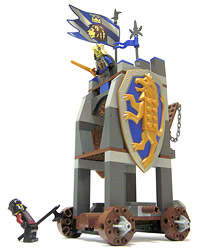
With no ladders, controls, or means of propulsion, the owner's manual for this siege tower must be truly fascinating.
| Elements shown:
LEGO Set 8875: "King's Siege Tower," slightly modified |
|
| Ablogical Binding Substance |
Ablogical Binding Substance, or ABS, is the prime construction material for the engineers of Galactik Civilization. Its mysterious properties allow fuelless vehicles, impossible structures, and reconstructible creatures. ABS is an unquenchable source of energy, thought, and motion - in short, all the inexplicable Plasticity that makes a BrikWar work.
The reality-warping effects of ABS allow Mediks to bring dead soldiers back to life, Mechaniks to create vehicles from debris in seconds, common housepets to mutate into unstoppable monsters, fully-staffed castles to materialize next to military bunkers, pirate ships to sail in outer space, and invading armies from parallel universes to arrive at the wrong battlefields a thousand years off schedule.
While the strange influence of ABS can never be fully defined or understood, minifig Mystiks believe that its effects radiate in tune with an underlying Farce that binds all briks together. Under the influence of this Farce, impossible and ridiculous events snap themselves to reality with a clutch power determined byhow entertaining they are, rather than following any logical rules of probability.
While this serves to make the universe more Ossum, there can be negative effects where cynicism and frustration take root. Minifigs who succumb to the Snark side of the Farce are dangerous opponents of fun, but for the heroic forces who are willing to face them down and destroy them, they are nothing more than further opportunities for glory.
The purest form of naturally-occurring ABS is found in Legitimitium ore, commonly shortened to Leg-Ore. Counterfeit Legitimitium Ore, or CLO, is cheaper to obtain than true Leg-Ore, but the use of CLOan bricks results in half-assed constructions and defective devices that enrage any pure-hearted minifig who encounters them.
Evidence of ABS having existed in previous universes reaches as far back as the 1,963rd RetKon, making it retroactively older than any known form of life by the span of over a dozen universes. It is believed that the presence of ABS plays a crucial role in the Rekonstructability of destroyed realities, and in the slow development of komplex life forms over many iterations.
|
Fancy Dice
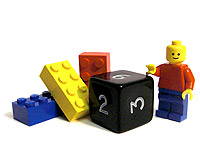
In order to keep things easy for beginning players, the Core Rules limit themselves almost entirely to regular six-sided cube dice (d6es), with an occasional d10 thrown in for the spicier bits. For custom MOCs, however, a wider variety of dice are required.
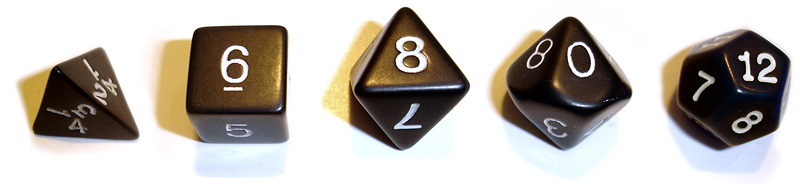
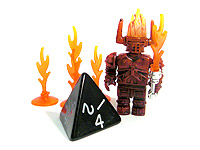
A d4, d6, d8, d10, and d12.
Fancy dice in all kinds of polyhedral configurations are available online or at gaming hobby stores. Any real tabletop gamer is already familiar with these and has several pounds of them immediately at hand.
Elements shown:
dice |
The wider range of dice are treated the same in MOC Combat as the d6es and d10s in the Core Rules (1.2:
Numbers). Each is referred to by its number of faces (a four-sided die is a "d4;" an eight-sided die is a "d8," and so forth). Any roll in which all the dice come up with a result of "1" is considered a Critical Failure, and any die that comes up on its highest-numbered face (an 8 on a d8, a 12 on a d12) generates a Bonus d6 for the roll (with the exception of the d4, which only ever generates Bonus d4s).
While all dice are handled in a roughly similar way, they each have an individual flavor dictated by tradition and superstition.
The Incompetent D4
Shape: Tetrahedron Average Value: 2.5 (3.33 with Bonus d4s) Used for: Mindlessness
What's the one requirement of a die? Players roll it and a number comes up.
As far as minimum performance standards go, this isn't a tough one to meet, but a d4 can't manage even that much. Numbers are scattered helter-skelter all over every face, and not a single one of them is "up." Players need a secret decoder ring just to figure out the result of the roll.
D4s aren't even that great when used as caltrops, since construction bricks have sharper corners and players tend to have a lot more of them.
The d4 is the most unsatisfying of all dice, and is used to represent incompetence and uselessness of all kinds. It is especially reserved for mindless destructive processes, like fire, disease, and consumerism.
The d4 is unique in that it doesn't earn Bonus d6es. On a roll of 4, all it gets is another Bonus d4.
The Basic D6
Shape: Cube Average Value: 3.5 (4.2 with Bonus Dice) Used for: Most Everything
Standard units and standard objects use the square and reliable standard d6. A d6 indicates a unit or object has the basic features or abilities to accomplish its duties, but is not otherwise exceptional.
Because the majority of units and weapons are based around the d6, players may end up needing huge piles of them if the battle is very large. Fortunately most gaming hobby shops sell uniform dice blocks of a few dozen small d6es for fairly cheap. Dice blocks in contrasting colors make the game experience a lot smoother, since every player will have plenty of their own dice and they won't have to keep passing a limited supply around the table.
The Specialist D8
Shape: Octahedron Average Value: 4.5 (5.025 with Bonus Dice) Used for: Special Training and Blast Weapons
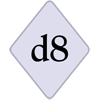
The d8 is used for advanced skills or special training. These are indicated on a unit's Stat Card, either in the stat boxes or in the unit's Specialty descriptions.
The d8 is also used for Blast damage that spreads over an arc, such as a dragon's breath weapon or a ShotGun blast.
The Heroic D10
Shape: Pentagonal Trapezohedron Average Value: 5.5 (5.92 with Bonus Dice) Used for: Structures, Explosions, and Heroes
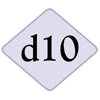
If something really awesome is happening, odds are good that d10s are involved. The d10 is used for siege-level weapons, vehicles, creatures, and fortifications, as well as for Heroes. They are also the die used for Explosion Damage, where the number of d10s determines the radius of an Explosion.
The SuperNatural D12
Shape: Dodecahedron Average Value: 6.5 (6.85 with Bonus Dice) Used for: Magikal, divine, and extradimensional effects
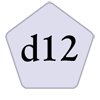
The d12 is rarely seen in BrikWars, and is reserved for unique SuperNatural entities and effects. Wizards, demigods, and superheroes may have access to d12s if they're powerful enough, but for regular mortal units (and even Heroes) this die is normally out of reach.
The d12 is also used for magical, chaotic, and energy-based types of damage that bypass a target's Shielded bonuses. Damage from the effects of lightning bolts, ghost launchers, and BrikThulhuian soul disruptors is measured in d12s that cannot be Parried or reduced by Heavy Armor.
The NonPossible D20
Shape: Nonexistent Icosohedron Average Value: Null Used for: Ensanity
The d20 is reserved for BrikThulhu alone. Even the tiniest brush with the effect of a d20 is rumored to strike a minifig cripplingly sane.
Endgames
In BrikWars, when players are finished having fun, then the game is over, even if the battle itself isn't finished yet. In the best case, everyone agrees on this at the same time. The game ends, and players can immediately jump to Kanon discussions to decide whether any side "won" and what the consequences were. Other times, some of the individual players might have already lost the battle, or at least have lost interest in it, while the rest of the table is still eager to keep going.
As a rule of thumb, as soon as any one player has lost half of their forces, it's a good time to stop and check how they and everyone else are feeling about continuing. If the tide of battle has brought a player or players to a point where they can no longer meaningfully engage, then it's time to kick off one or more Endgames.
Mob Rule
If a player has to leave immediately, whether due to ennui, diaper-related emergency, or fatal brain aneurysm, the battle doesn't have to end. That player's forces become Mobs, and they (along with any other non-player-affiliated units in the game) are controlled by Mob Rule.
Forces abandoned by their animating Human suffer an immediate crisis of leadership. On a Mob faction's turn, the remaining players take turns picking Mob units one at a time and controlling their Movement and Action. This continues until all of the Mob units have moved for the turn, or until half of the remaining players have declined to control any more of the Mobs for that turn.
When choosing the turn order for controlling Mobs, the player or alliance with the fewest forces remaining goes first (if it's obvious), or the order is determined by rolling dice (if it isn't). If players have formed alliances, then the alliances each take turns controlling Mobs, rotating between players within the alliance as necessary.
| Mob Rule Example: Work Zombies |
Example: The zombie apocalypse has broken out in the offices of TPS Reports Inc, and the long-simmering office factions are at each other's throats. Middle Management and Security have formed an alliance with the Executives, Housekeeping has teamed up with IT Support, and the Cubicle Dwellers are on their own.
The Zombies are Mobs, and on their turn the three alliances take turns controlling them with Mob Rule. Depending on the urgency of their situations, they might choose the most powerful zombie units to keep other players from controlling them, the zombies closest to themselves to move them farther away, the zombies closest to their enemies to press the attack, or whichever zombies are in the best position to do something hilarious.
Although the Executives are the smallest individual faction, their alliance with the Middle Management and Security is the largest in the battle. Instead, the Cubicle Dwellers take the first turn at controlling a Mob zombie. The turn order is as follows:
1: (No alliance:) Cubicle Dwellers move Rob the zombie Hero
2: Alliance 2: IT Support moves a zombie squad
3: Alliance 1: Executives move a zombie hot dog cart
4: Cubicle Dwellers move a zombie out of a squad
5: Alliance 2: Housekeeping moves the rest of the squad
6: Alliance 1: Security moves a lone zombie
7: Cubicle Dwellers move a zombie
8: Alliance 2: IT Support decides to pass. Their ally Housekeeping moves a zombie again instead
9: Alliance 1: Middle Management moves the zombie triceratops
10: Cubicle Dwellers pass
11. Alliance 2: Housekeeping moves a zombie
12. Alliance 1: Executives pass
There are still zombies who haven't moved, but half of the players (three out of six) have decided to pass, so the Mob turn is now over. |
Depending on the agreement of the remaining players, a faction taken over by Mob Rule might continue to behave rationally (or as rationally as they ever did), or there may be no boundaries on what players make them do. A Mob faction may keep its own turn or be combined into a single turn with other Mob forces already in the battle.
Escalation
| “...the demand was for constant action and if you stopped to think you were lost. When in doubt have a man come through a door with a gun in his hand. This could get to be pretty silly but somehow it didn’t seem to matter.” |
| - Raymond Chandler |
If a battle is bogged down by turtling forces and tactical stalemates, it doesn't mean players have to helplessly watch as the battle winds down into tedium. Instead, players can turn up the action.
- Escalation
Forces that are desperate or pressed for time can redouble their efforts, hitting harder but overextending themselves and increasing their own danger in the process. For a faction that chooses the Escalation endgame, combat effects are accelerated by an Escalation Bonus that's added to each of their own forces' Skill and Damage Rolls, but that's also added to any Skill and Damage Rolls made against them.
An Escalating faction starts with an Escalation Bonus of zero.
At the end of each of the faction's turns, if any of its forces have killed, destroyed, or captured at least one Enemy unit, its Escalation Bonus increases by one point. (A player can keep track of his or her current Bonus by setting a designated die aside, turned to the appropriate face.)
Because the Bonus increase occurs at the end of their turn, all of the faction's Enemies will receive the advantage of the increased Bonus before they do. Escalation is dangerous!
- Crescendo of Violence
If all players at the table agree to accelerate the action together, they can start an Endgame Crescendo of Violence. The next player receives a single Instant Benny at the start of his or her turn. From that point forward, at the beginning of each player's turn, the new player receives one more Instant Benny than the player before them, with no upper limit.
- Secret Factions
If a battle is getting too predictable, or if a new Human shows up unexpectedly and wants to join the fight, players can throw in a wild card with the arrival of a Secret Faction. This depends on having extra forces already built and available to deploy, but for many Human toy collectors this isn't a problem.
If a Secret Faction is introduced without a player standing by to take control of it,
the arriving forces can be treated as a Mob army, with units controlled by all players in rotation.
Fighting a Losing Battle
Soldiers that are losing a battle still have opportunites for glory. Players who accept that they're Fighting a Losing Battle receive special bonuses as their forces go down in flames. But there are no take-backs - no matter how well they do from that point forward, at the end of the game, those players lose, by whatever Koincidental disasters players have to make up to make it happen.
- The Suicide Run
Forces that still have a chance to achieve at least one of their objectives, but only if no one gets out alive, can go on a Suicide Run. From that point forward, any time one of their units is killed or destroyed, they immediately recieve one Instant Benny.
Regardless of whether they achieve their objective, at the end of the battle, none of their units survive. Characters that absolutely must survive are either captured by the enemy or they dramatically abandon their faction at the end of the battle.
- The Blaze of Glory
Forces that have already lost the battle, but who'll be damned if they don't take their Enemies with them, can go down in a Blaze of Glory. From that point forward, any time they kill or destroy any Enemy unit, they receive one Instant Benny.
At the end of the battle, no matter how many Enemies they kill on the way out, they lose. The best they can hope for is to make sure none of their opponents win either.
- No Man Left Behind
Forces that can't achieve any further objectives and who are determined to regroup and fight again can stage a tactical retreat with No Man Left Behind. From that point forward, any time they evacuate one of their own minifigs off of a "safe" side of the map - living, dead, or otherwise - they receive one Instant Benny.
At the end of the battle, any objectives the player had already achieved before retreating still count as victories. Objectives achieved after calling the retreat are Koincidentally undermined somehow. Any forces that successfully escape live to fight another day. Evacuated casualties may or may not recover, according to the needs of the story.
The Kanon
| Humanity |
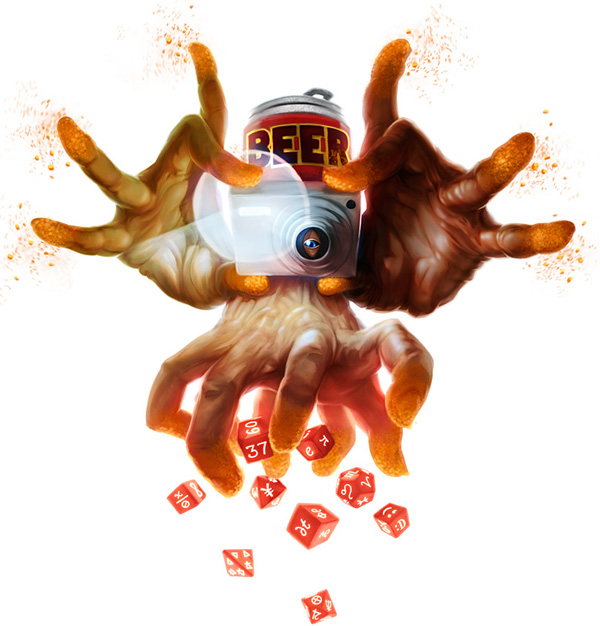
The mysterious Human overlords rule over all the forces of Kanon. Minifig Clerix teach that a Human is a kind of sentient beer can that grows cheez-powder-flavored meat hands and throws Dice when angered. |
When grappling with the infinite possible BrikVerses incipient in a Human's pile of bricks, the construction of physical Creations is only the first step. The realities in which those Creations exist are weak and nebulous, only gaining definition as Humans stage battles and adventures within them.
Minifigs expect battles to last until the last soldier, robot, or undead teddy bear falls. In reality, the action stops when the Humans lose interest. Toys are only real for as long as Humans believe in them, and so the wiser toys live in terror of losing their Human's animating faith. More important than any battlefield victory, minifigs must capture and hold a Human's interest in order to continue existing. Not only are unmemorable conflicts abandoned, forgotten, and erased from reality, but they create the risk of starting a Dark Age in which a fickle Human turns its attention away from toys completely, to unfathomable and alien subjects like "video games" or "dating."
|
| "'It doesn't happen all at once,' said the Skin Horse. '"You become. It takes a long time. That's why it doesn't happen often to people who break easily, or have sharp edges, or who have to be carefully kept. Generally, by the time you are Real, most of your hair has been loved off, and your eyes drop out and you get loose in the joints and very shabby. But these things don't matter at all, because once you are Real you can't be ugly, except to people who don't understand.'" |
| - Margery Williams, The Velveteen Rabbit |
Creations and storylines in a BrikVerse have varying degrees of reality, determined by their Human's level of interest in them. This ontological clutch power is called Kanon. For minifigs, the true spoils of a BrikWar aren't the enemies slain or the bricks looted, but the chance to be immortalized in Kanon.
At a battle's end, whether due to victory, defeat, or just running out of time, Human players should pause to drink and feast and celebrate their minifigs' deeds.
Players reflect on which characters, events, and creations were the most epic, and which outcomes were most important to the world and storyline. Sometimes, but not always, this will include who won the battle. Just as often, players will raise a toast to the characters that failed most heroically. Sometimes it will be about the forces who ignored their nominal goals completely and managed to achieve something ridiculous and majestic in spite of them. Sometimes it will be about the destruction wrought when the cat jumped on the table and proved herself the deadliest combatant of all.
For better or worse, these are the Kanon events that create a minifig civilization's reality. Everything else is just trivia.
| BrikVersal Recursive Inductive Konstructivism |

The underlying nature of the BrikVerse, according to the best observations of minifig science, is an Irrealist Kosmology resulting from Inductive Konstructivism via the Introduction of Kanon.
The BrikVerse came into existence with the most significant Kanon event to ever occur: the appearance of the Deadly SpaceMan. The DSM's unprecedented Ossum created a force of Kanon which expanded forwards and backwards in time, creating both a past series of events leading up to his appearance and a future set of events resulting from it.

In superficial BrikVersal time, one event leads to another in sequence in a manner familiar to Humans. However, as shown by the arrival of the Deadly SpaceMan, events that are particularly notable or disruptive can gain the power of Kanon and force changes to events elsewhere on the timeline for the sake of Internal Konsistency. Changes to past events are called Retkons and occur by a process of Inverse Kausality.

The Deadly SpaceMan was Ossum to begin with, and as the DSMs multiplied, their Ossum compounded. Before long, warring DSM empires had conquered the entire original BrikVerse. The DSM Wars accelerated the generation and magnitude of Kanon so quickly that new events were Retkonning themselves faster than they could even occur in the first place, finally culminating in a recursive cascade collapse singularity. The entire BrikVerse timeline and everything in it detonated outward in an explosive Kanon ball.
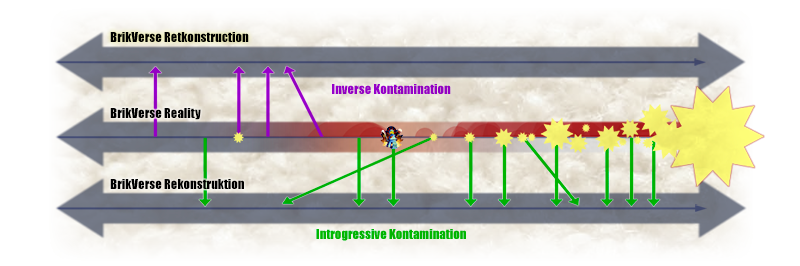
Just as the first DSM's arrival caused the generation of both past and future reality, the destruction of the DSMs' BrikVerse created both preceding and subsequent generations of BrikVerses.
Incomplete and scattered chunks of the original BrikVerse's history and reality, known as Particle Kanons, became seeds of Ossum for new and rekonstructed BrikVerses. Events and characters from the original Kanon reappeared in the new timeline, but not always in the correct order or locations, and the empty sections of history that weren't able to hide and avoid Human detection were forced to fill themselves in as best they could along slightly different lines than the original version.
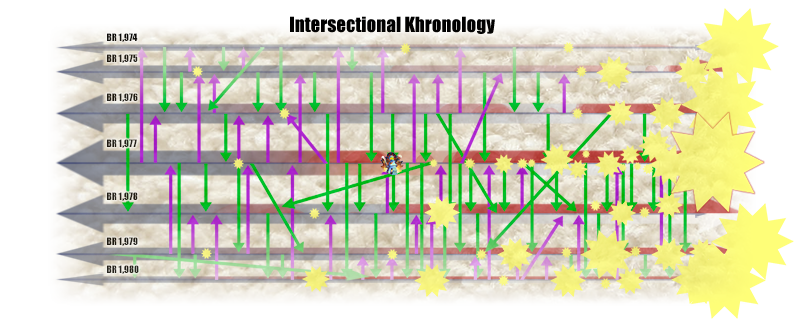
Naturally, some Particle Kanons carried Deadly SpaceMen along with them, and the introduction of DSMs into the new BrikVerses had the same result as in the original. Their influence caused inevitable escalating Ossum until Infinite Kanon was breached and the new BrikVerses exploded as well, sending chunks of themselves forward and backward into Rekonstructed and Retkonstructed versions of their own, and even paradoxically re-seeding each other and the original BrikVerse from which they'd been spawned.
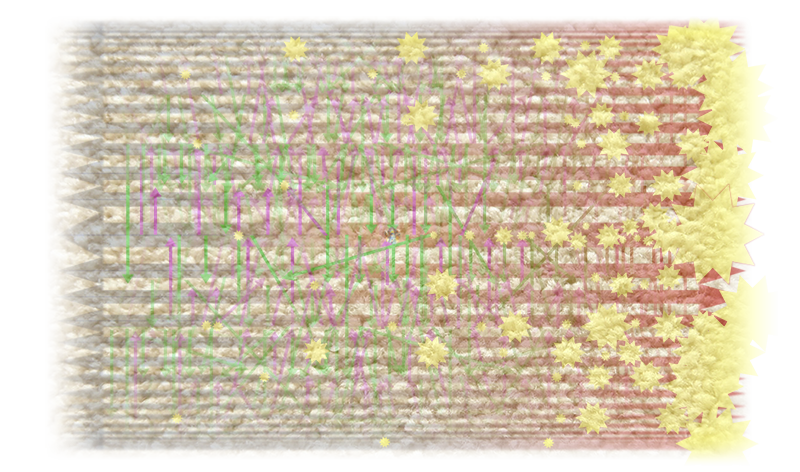
The compounding effects of infinite Particle Kanons from each timeline influencing all other timelines resulted in densely Inter-Konnecting versions of each discrete timeline. Each of these in turn exists in self-conflicting versions with its own NegaVerses and other mirror dimensions under the stewardship of unwitting and unrelated Humans.
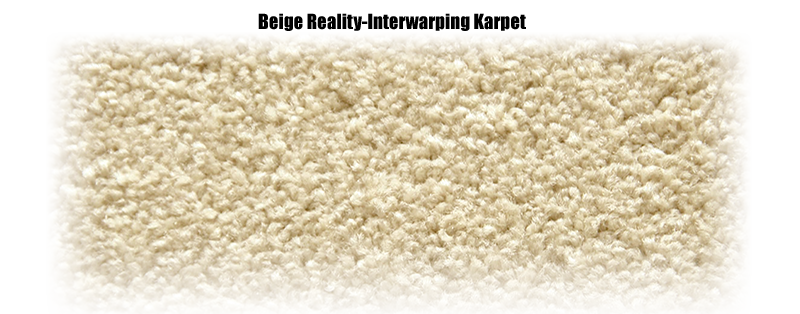
This vast network of intersecting Kanon is all woven together in the cross-dimensional multiversal warp that makes up the underlying fabrik of reality: the Beige Karpet. All of the prime rectangular planes of reality, including the Dining Room Table, the Bookshelves, and the Work Desk, have the beige carpet as their supporting foundation.
|
|
|