Chapter Seven: Structures
| “Creative powers can just as easily turn out to be destructive. It rests solely with the moral personality whether they apply themselves to good things or to bad. And if this is lacking, no teacher can supply it or take its place.” |
| - Carl Jung |

The Assyrian warship Sonks, captained by the legendary Major Natalya and constructed around the unstoppable Hyper Phase Cannon, is the most decorated ship in the Assyrian military. After first seeing action as a Longinus IV-B class Assyrian Corvette, the Sonks has been retrofitted into a Venus class Destroyer in response to the escalating threat from the Stranian capital ship Hodgepodge and its supporting fleet.
Once a decent-sized Creation like the Sonks enters the game, the all-minifig style of combat described in the Core Rules seems inconsequential at best. |
|
There is no environment more dangerous to minifigs than the flat open field of an empty dining room table or hardwood floor.
This is not to discount the hazards offered by minefields, quicksand patches, black holes, and molten lava, but all they can threaten is simple mutilation or death. To the fighting minifig, a featureless plane is much more terrifying. Without strong points to exploit, choke points to control, dangers to avoid, and vistas to annihilate, minifigs face the danger of becoming tactically disoriented, or worse, bored.
Adding insult to injury, minifigs are tender, fragile, and slow compared to armored vehicles and other large units. Without cover to duck behind, they have a tendency to get ground up like plastic hamburger meat.
Ideal battlefields are populated with enough Structures to give minifigs a satisfactory range of tactical options. Whether with walls and fortifications, trees and rivers, peaks and valleys, cliffs and caves, or gas stations and convenience stores, the more variety that's available to minifigs in the field, the better.
7.1: Structure
| “Some scientists claim that hydrogen, because it is so plentiful, is the basic building block of the universe. I dispute that. I say that there is more stupidity than hydrogen, and that is the basic building block of the universe.” |
| - Frank Zappa |
Underneath all the devices and decorations, every physical object in the BrikWars universe is a Structure at heart, from the minifig and his weapon and the grassy knoll on which he's crouching, to the public library and the orphanage he's targeting for orbital bombardment. The majority of these Structures are simply handled as free scenery, not owned or paid for by any player, but it's still important to be able to cook up some quick attributes to know how efficiently they can be reduced to smoking craters.
Structure vs. Non-Structural Elements
The foundation of any Creation is its central Structure,
upon which Non-Structural Elements (limbs, weapons,
devices, decorations, etc.) are mounted. As a rule of thumb, any section of
the Creation with an 'interior' (whether for cargo, minifigs,
machinery, or vital internal organs) is Structural.
Non-Structural Elements
Any parts that are decorative, moving, have activated functions,
or are otherwise not an integral part of the main Structure
are Non-Structural Elements. This includes Weapons and Devices mounted on the surface of a Structure, as well as interior objects like furniture, security systems, and intestines.
Weapons and Devices must be bought and paid for (Chapter 8: Weaponry),
but other Non-Structural Elements are free, and great for adding color and interest
to an otherwise humdrum battlefield.
| Structural and Non-Structural Elements |
| Creation Type |
Structural Elements |
Non-Structural Elements |
| Building |
walls, floors, basement, roof, load-bearing
columns |
furniture, machine gun nest, satellite
dish, drawbridge, searchlights |
| Vehicle |
chassis, cockpit, fuselage, cargo
hold, trailer |
wings, rockets, wheels, laser cannon,
crane arm, shield generator, fuzzy dice |
| Creature |
skull, torso, trunk |
limbs, wings, jaws, tail, fins, tentacles,
weapons, bunny slippers, brains |
|
Structural Attributes
A Structure has two main attributes: Size and Structure Level, which together determine its Base Cost.
Size
 To
determine a Structure's Size, players take the physical model and measure the
number of inches along the longest dimension of its Structural section, ignoring Non-Structural Elements like wings or missile launchers.
A wall's longest dimension is its length, a tower's is its
height, a sphere can be measured across the diameter, and so forth.
The number of inches measured
is the Structure's Size rating. Players can round fractions
upward or downward according to preference. To
determine a Structure's Size, players take the physical model and measure the
number of inches along the longest dimension of its Structural section, ignoring Non-Structural Elements like wings or missile launchers.
A wall's longest dimension is its length, a tower's is its
height, a sphere can be measured across the diameter, and so forth.
The number of inches measured
is the Structure's Size rating. Players can round fractions
upward or downward according to preference.
A Structure's Size determines how many Weapons and Devices it can activate in a turn, how many times it can be damaged before it's destroyed, and its maximum Structure Level.

| The variety of possible Creatures is limitless, but gauging their relative strength is as simple as measuring the lengths of their spinal column and cranium. Tails and jaws are excluded. |
|
Most Structures have a minimum Size of 1, but for very small single-piece Creatures
(snakes, bats, scoprions, and parrots, for instance), a Size rating
of zero is allowed. These tiny zero-Sized Creatures are called Vermin and do not recieve a Structure Level like other Creations. By default,
Vermin have Size zero, zero points of Armor, and a Base Cost of zero CP.
Structure Level
 A
Structure's Armor is determined by its Structure Level.
A Creation's Structure Level is chosen by the player, according
to what seems most appropriate, with a maximum Structure Level equal to the Creation's Size. A
Structure's Armor is determined by its Structure Level.
A Creation's Structure Level is chosen by the player, according
to what seems most appropriate, with a maximum Structure Level equal to the Creation's Size.
| Structure Levels |
Structure
Level |
Armor
Rating |
Minimum
Size |
Equivalent
Materials |
Building
Example |
Vehicle
Example |
Creature
Example |
| 0 |
0 |
0" |
glass, paper, soap bubbles |
tent |
hot air ballon |
butterfly |
| ½ |
1d6 |
½" |
rope, drywall, plastic, flesh |
plastic outhouse |
hang glider |
minifig |
| 1 |
1d10 |
1" |
wood, sheet metal, steel cables, kevlar |
wooden outhouse |
sports car |
troll |
| 2 |
2d10 |
2" |
brick, log walls, wrought iron |
brick outhouse |
pirate ship |
dragon |
| 3 |
3d10 |
3" |
concrete, stone, steel plating |
castle |
tank |
stone golem |
| 4 |
4d10 |
4" |
heavy steel, reinforced concrete |
nuclear bunker |
capital starship |
Olympian god |
| 5 |
5d10 |
5" |
adamantite, kanon |
BrikThulhuminati pyramid |
Dungam mobile suit |
Human |
|
As long as it's never greater than the Structure's Size, a Creation's Structure Level is entirely a judgment call on the part of the players. The
Armor of a dragon, for instance, might be anywhere from 1d6 to 3d10
depending on its size, age, and type.
Any exposed hinges,
turrets, pivots, or other moving attachment points are considered weak points on a Structure. Except in special cases agreed on by the players, weak points, Non-Structural Elements, and interior walls have a Structure Level one level below that of the Structure they're mounted on, to a minimum Structure Level of ½ and Armor Rating of 1d6 (unless the main Structure is already at Structure Level zero, in which case they're also zero).
Incidental decorations and other objects mounted to the Structure
may have higher or lower Armor Ratings as seems appropriate to their particular nature.
Base Cost
Base Cost: (Size" x Structure Level) CP
 The larger
and more heavily-armored a Structure is, the more it will cost. Once
the Size and Structure Level have been determined, they're multiplied together to determine the Structure’s Base Cost. A player must pay
this many CP in order to build the
Creation's central Structure. The larger
and more heavily-armored a Structure is, the more it will cost. Once
the Size and Structure Level have been determined, they're multiplied together to determine the Structure’s Base Cost. A player must pay
this many CP in order to build the
Creation's central Structure.
Additional devices and abilities, such as Weapons (Chapter 8: Weaponry) and Propulsion systems (Chapter 9: Vehicles), must be purchased separately.
7.2 Taking Damage
| “All created things are impermanent.” |
| - Buddha |
For minifigs and other small Creations (Size 1" or less), injuries
are simple to deal with. Damage higher than their Armor rating kills or destroys
them; Damage of an equal or lesser amount has no effect.
For a larger Creation, overcoming the Armor rating
doesn’t grant an instant kill. Depending on how large the Creation
is, the Damage might only weaken it by stages or break off chunks
of individual bricks.
When attacking a large Creation, players can handle the Damage in
two ways. General Damage treats a Creation's Size inches as a type of hit points, allowing attackers to harm the Creation as a whole, weakening its overall
abilities and wearing it down by attrition. Component Damage lets attackers focus on destroying individual systems or severing construction
element connections rather than hurting the overall Structure.
General Damage
Targeting a Creation for General Damage doesn't take
a lot of precision – the attacker just has to be able to target
any part of its central Structure (7.1: Structure).
This will often grant a nice bonus to the Attack Roll, since the attacker
can take a Size bonus for however much of the Structure is visible
to him (+1 bonus per 2” target Size; see 5.1: Making Attacks).
Size Damage
As when attacking minifigs, General Damage must first exceed the target’s
Armor to have any effect. If it does, the target Creation takes one
point of Size Damage, represented by sticking a colored Damage
Pip to a prominent spot on the Creation or its baseplate. Black
or red 1x1 bricks are the usual choice for Damage Pips, although other
elements may be used for convenience or better visibility.
When a Creation has taken Size Damage, the model remains the same physical size, but the Creation's Effective Size is reduced by one inch for each point of Size Damage. Its Size-based abilities are now limited by the new Effective Size instead. The Power limit on the number of Weapons and Devices the Creation can activate during a turn (8.1: Weapon Size), its maximum Momentum in a Charge (9.5: Collisions), and its maximum Structure Level (7.1: Structure) are all decreased to match the new Effective Size. Additionally, if the Creation takes enough Size Damage to reduce its Effective Size to half its original Size or less, then the Creation moves at Half Speed.
| When a Creation's Structure Level is decreased by Size Damage, its Surface Elements and moving parts are also weakened accordingly, to a minimum Structure Level:½ and Armor:1d6. |
Any positive advantages that might result from a smaller Effective Size, such as a decreased targeting bonus for attackers, are ignored. The Creation's Size as a physical target hasn't decreased, only its ability levels.
If Size Damage is enough to reduce a Creation's Effective Size
to zero, then the Creation is destroyed in the manner that seems most appropriate.
Towers collapse, spaceships explode, whales go belly-up, zeppelins
burst into flame, and pirate ships sink to the briny bottom. Creations
of Size 1" (and Vermin of Size 0") are destroyed on the
first point of Size Damage.
| Size Damage Example: Super Heavy Death Tank |
Example: The Briktopian military has received reports of a small bar serving Maniac Beer to its patrons - a serious offense! The Super Heavy Death Tank "Vindicator" is sent to defend Briktopian liquor licensing regulations by destroying the bar and all its patrons.
The SHDT Vindicator is so large that it serves as a carrier vessel for lesser tanks, and with an Armor of 4d10 it can absorb a huge amount of Damage for each of its 12 inches of Size. An opposing force would have to be fools to try to take it down with general Size Damage rather than with more precisely targeted attacks, but - under the influence of Maniac Beer - the bar's patrons attempt exactly that.
| Size 12" SHDT Vindicator |
Size
Damage |
Effective
Size |
Structure
Level |
Armor |
Movement |
Power Limit |
| None |
12"
(Actual Size) |
4
(Full Strength) |
4d10 |
Full Speed |
24"
(Full Power) |
| 1 |
11" |
22" |
| 4 |
8" |
16" |
| 6 |
6" |
Half Speed |
12" |
| 8 |
4" |
8" |
| 9 |
3" |
3 |
3d10 |
6" |
| 10 |
2" |
2 |
2d10 |
4" |
| 11 |
1" |
1 |
1d10 |
2" |
| 12 |
0" |
Destroyed |
|
|
The first few points of Size Damage are enough to immediately start decreasing the Vindicator's attack capacity. At six points of Size Damage, it's lost half of its Effective Size and is reduced to Half Speed. It takes nine points of Size Damage before the SHDT's Effective Size is reduced below 4", causing decreases to its Structure Level and Armor.
In theory, at twelve inches of Size Damage, the Vindicator's Effective Size is reduced to zero, and the tank is destroyed. The chances of a handful of drunken bar patrons accomplishing this are slim to none, however. |
Component Damage
When an attacker wants to focus damage on a Creation’s
particular weak point, he may single out individual construction
elements for Component
Damage. This takes a little more accuracy than a General Damage attack
- many elements are small enough to incur Attack Penalties for size (5.1:
Making Attacks). The advantage is that Component Damage can be used to disable or destroy specific devices and systems, which tend to be less heavily armored than the main Structure.
If Component Damage exceeds the target element's Armor rating,
then the element is chopped, smashed, or blasted off of the Creation. The attacker removes either a single building
element or a chunk of bricks up to 1” in Size. Where possible,
players should try to make the damage appropriate to the attack
type – piercing armor plating with an energy blade makes a
more precise cut than pounding it with mortar fire.
| Explosives are especially satisfying when used for Component Damage, as they can potentially destroy a large number of Components in their blast radius at once. |
If a Creation is made up primarily of a single very large element, such as a towering Cthuloid Furry Horror made out of a stuffed teddy bear, it's
poor form to try and use Component Damage to destroy the
whole thing in one hit. Use General Damage, or choose a specific
feature to disable rather than destroying the whole element.
Applications
The precision of a Component Damage attack allows for several
possible applications. A tank's armor, a castle wall, and a dragon's
ribcage can all be breached to expose the juicy innards to more
effective follow-up attacks. Critical devices like steering wheels,
helicopter blades, and kneecaps can be targeted and disabled individually.
By targeting narrow connection points (the tail section of a helicopter
or the waist of a giant wasp), a successful Component Damage attack
can divide one large Creation into two or more smaller ones. The Size
Ratings of the new smaller Creations are reduced to reflect their
new stature, but each then inherits the full Size Damage of the original
Creation, which may mean that one or both are instantly destroyed.
Each section may use whichever weapons and devices remain attached
to them, but only if they still have the necessary remaining Size rating and
controls to activate them (Chapter 8: Weaponry).
Special Damage
When the Damage from an attack is much higher or much lower
than the target's Armor rating, players may decide to use special
forms of Damage to account for the effects. Special Damage takes a little more work than the usual kind and should be saved
for appropriately special occasions.
Grinding
Given enough time, a woodcutter's axe can chop down a telephone pole, a battering
ram can beat down reinforced gates, and a hammer and chisel can punch
a leak in the hull of a submarine. When the Armor of a target is too
great to ever be overcome in a single attack, Grinding Damage can be used to grind down the Armor of specific components over the course of several
turns.
Grinding can only be used in Component attacks. Grinding is different from a regular attack, and a player must declare
that he is Grinding before rolling for Damage. Rather than comparing
the Damage total to the target component's Armor rating, he instead compares the result
on each individual Damage die to the component's Structure Level (e.g.,
a component with Armor rating 4d10 has a Structure Level of 4 (7.1:
Structure)). For each die that comes up greater than the
Structure Level, the component receives one point of Grinding Damage
(use Damage Pips to keep track of this as necessary). These points of Grinding Damage
are permanent, and are subtracted from the component's Armor for all future attacks.
Overkill
Normally, points of Damage in excess of a target's Armor rating are ignored. If an attack is so powerful that the leftover Damage can be effective all over again, then that excess can be treated as Overkill Damage. Especially powerful attacks may cause enough Overkill Damage to inflict
multiple points of Size Damage on the same target, destroy several Components all at
once, or even blow through multiple targets.
 |
12 points of Damage is enough to kill multiple minifigs if they all happen to be standing in the line of fire.
12 Damage kills the first minifig. After overcoming his 4 Armor, 8 points of Overkill Damage remain.
8 Damage kills the second minifig. After overcoming his 4 Armor, 4 points of Overkill Damage remain.
4 Damage is enough to match the third minifig's Armor but not defeat it. The remaining minifigs survive. |
When an attacker makes a successful attack and decides to go for Overkill, he keeps track of the total Damage inflicted and the defender's unsuccessful Armor Roll against it. After applying the appropriate Damage destruction from the initial attack, he then subtracts the result of the Armor Roll from the Damage done to find out how many points of Damage were "left over." This new total becomes Overkill Damage, and continues in the path of the original attack, doing more of the same type of damage (either General or Component Damage) to whatever objects it hits.
When an attacker causes General Overkill from a General Damage attack, he will most often be inflicting multiple points of Size Damage against a single target. If any of these reduce the target's effective Size enough to lower its Structure Rating, all successive points of Overkill are applied to the target's new, lower Armor Class, in a nicely vicious cycle.
When Component Overkill results from Component Damage, the attack destroys the initial target Component and proceeds forward to the next Component immediately behind it, potentially burrowing all the way through the Structure and bursting out the other side. Component Overkill can benefit from the fact that the Structure Level of interior Components is normally one level lower than exterior ones, so attackers can cause damage more easily once they've punched through the tough outer shell.
Best of all, if General Overkill is enough to destroy the initial target, or Component Overkill is enough to blast right through it, then the Overkill Damage may continue out the other side as Target Overkill to strike whatever new targets fall along its path. Target Overkill travels in a straight line determined by the direction of the attack and where it struck the target, and is limited by the range of the attack - a battleaxe is limited by the maximum
reach of its swing, a laser blast by its maximum linear range, and
a Charging bull by the maximum distance it's able to run in a straight
line.
When the attacker wasn't specific about which part of a target he was aiming for, assume that the attack struck the closest, largest, and most generic part of he target - the center of a minifig's torso rather than the brainpan or groin, for example.
If the attack location was too-Koincidentally chosen so that the Overkill Damage would happen to hit a target or component the attacker couldn't have known was there, that's in pretty poor taste. It's one thing to fire at a vehicle cockpit and happen to hit the pilot; it's another to fire at the one spot on a blank wall that happens to have a security guard on the other side. In cases of obvious metagame shenanigans, the defending player can declare by fiat which location on the target was struck by the attack, and then kick the attacking player in the shin. |
When Target Overkill threatens to strike units positioned behind the original target, they can attempt to Bail or Parry the attack as if they were the original target.
7.3 Field Construction
Minifigs are no fans of Actions that fail to result in violence, but they try to take a tolerant attitude towards the occasional need to put stuff together. Otherwise, the reasoning goes, they'd run out of stuff to blow up, and stuff to blow it up with.
When a minifig is carrying a construction element and tries to connect it to something, he succeeds automatically. Attaching elements to each other costs no Movement and requires no Skill Roll. Minifigs have been bred for this specific task for generations, and are very efficient at it. Attaching construction elements together costs an Action, but with that single Action they can spend the turn attaching as many construction elements as they can physically move into position.
Makeshift constructed objects (or constructed sections added to other objects) have an Armor rating of 1d6 by default.
Carrying Items
A minifig's ability to assemble Structures is limited only by his ability to gather building elements together.
A minifig can pick up, carry, and drop an element (or group of elements) up to the size of a 2x2 brick with one hand, at no cost to Movement or Action. Using both hands, he can carry a load up to a 2x4 brick in size just as easily, although he can no longer Sprint. He can push or drag a larger object or group of objects around at Half Speed, up to 2" in Size.
As a more general rule, a Creation with the ability to carry things can pick up and carry an object its own Size at no cost, and push or drag an object twice its Size at Half Speed. If minifigs work together to combine their strength, they can add their Sizes together to combine their carrying capacity. If a Size 0" Vermin (10.4: Monsters) is able to carry objects, it can carry one minifig equipment item at no penalty, or two equipment items at half speed.
The Mechanik
| “Engineers are all basically high-functioning autistics who have no idea how normal people do stuff.” |
| - Cory Doctorow |
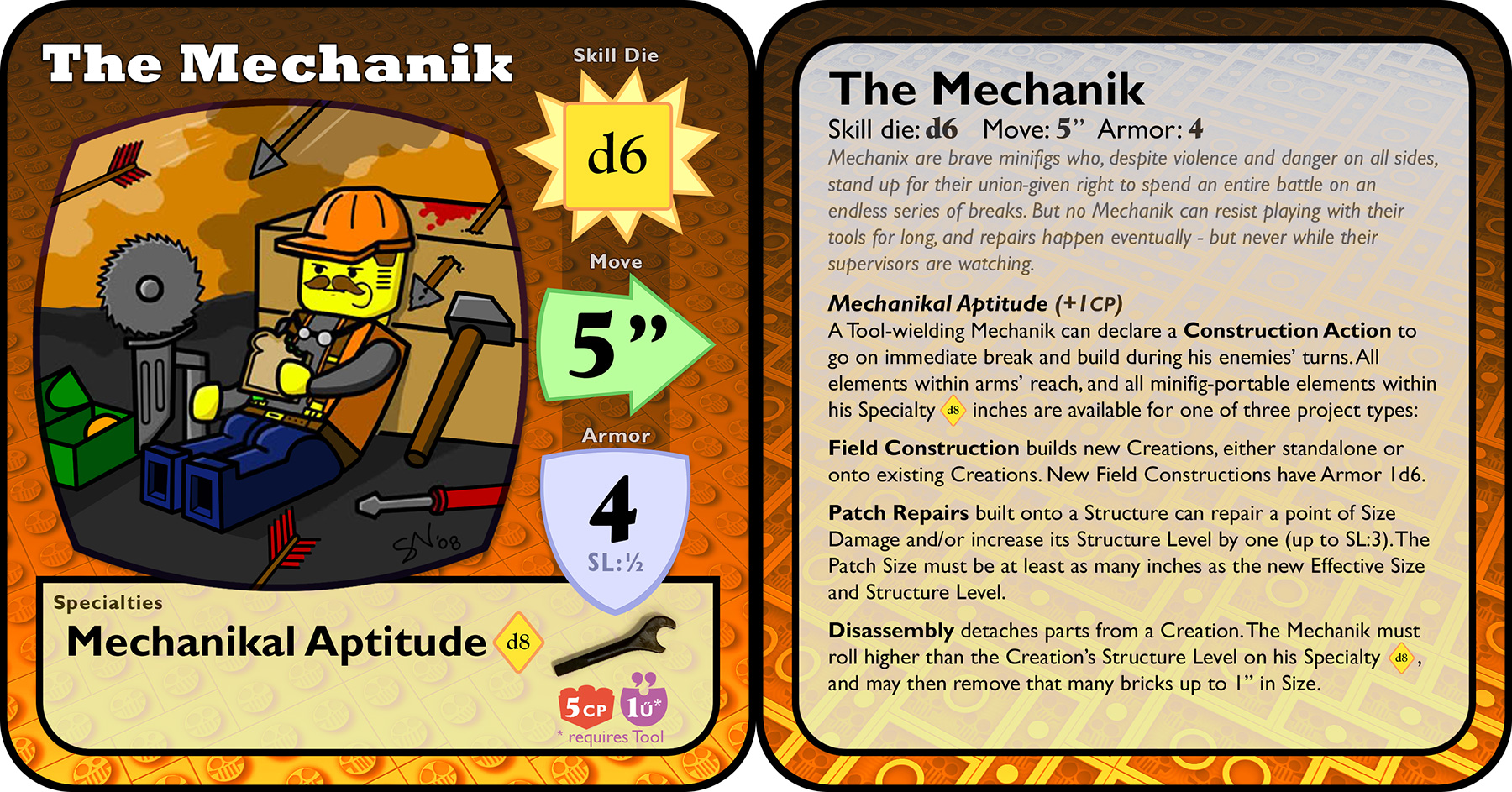
While any minifig can slap some rubble together and call it a day, there are a few brickbuilding savants who, thanks to rigorous education and natural genius, earn the right to wear a hard hat and carry around actual tools. These licensed Mechanix have the ability to assemble masterworks of engineering on the fly, even in the middle of pitched battles.
Mechanikal Aptitude
Mechanikal Aptitude Specialty (+2CP): allows the Construction Action on enemy turns within a d8" radius ( ) )
A Mechanik has the advantage of Mechanikal Aptitude, which allows him to use Construction Actions to build, repair, modify, and disassemble creations without respect to logic or common sense. Whenever engaging in one of these activities, a Mechanik uses his Mechanikal Skill of d8 rather than his usual d6.
The Construction Action
When constructing
elements into new Creations or modifying existing ones, Mechanix are free to attach a loose brick here or there during their turn like any amateur. For the really big jobs, though, they need to declare a Construction Action and abide by union rules.
UNION RULE 1

Mechanix don't collect their own bricks. |
|
No matter how hardworking an individual Mechanik might be in private life, the professional standards dictated by the Mechanix' Union require him to be as lazy as possible on the job, in order to protect the hard-won rights of his union brothers. This means that Mechanix avoid collecting their own bricks whenever possible.
Instead, when a Mechanik declares a Construction Action, he rolls his Mechanikal Skill of d8 () to determine his Construction Radius. Within that many inches from where he's standing, he may then use all loose chunks of construction elements small enough to carry as if he had taken the trouble to collect them himself. Objects too large to carry can be included in Construction as well, but, unlike the smaller pieces, they must already be within arm's reach. Mechanix can treat any Structures and Vehicles that have been destroyed by Size Damage (that is, their Effective Size has been reduced to zero) as if they were already completely broken apart into component elements, even if they are still otherwise intact.
While Constructing, the player is allowed to take this collection of elements off to one side of the battlefield in order to work with them more easily, but they are all considered to still be on the field, and are still subject to attacks at that location by marauding opponents.
If any bystanders get too curious about how a Mechanik is able to use bricks without gathering them first, they find themselves having a chat soon afterwards with some of the local union boys, and they learn to not be so curious in the future.
| Two Mechaniks working together can combine their Construction Radius rolls, but it doesn't give them any more time to Construct stuff. |
UNION RULE 2
Mechanix don't work on their own turns. |
|
Union rules dictate that Mechaniks are always On Break during their own turn. Break begins the moment the Mechanik declares a Construction Action and lasts until the end of the turn. It's only afterwards, when his opponents are taking their turns, that he really gets down to business.
All Construction Actions take place during the Mechanik's opponents' turns. This has two advantages: first, it gives the Mechanik's player something to do while waiting for his or her opponents to move, and second, it encourages opponents to hurry up, since the longer they take, the more work the Mechanik can get done.
The Mechanik's player must take care to never let a Construction Action stall the game. If he or she is called on to make a roll, if the Mechanik or his Construction are attacked, or if the opponent's turn ends, the player must immediately pause working on the Construction, regardless of the state it's in. The player can return to working on it once the interruption is resolved, if the Mechanik is still alive and in a position to do so.
Field Constructions
Mechanix are best known for their ability to create machinery and fortifications from rubble, either as new Creations (a new assault helicopter, a new castle tower) or as objects to add to existing Creations (a new giant robot fist for the copter, a new lightning gun for the tower). These are limited only by how fast the player can build, and by the parts available within the Mechanik's range.
A Mechanik's Field Constructions have the following stats, whether finished or in progress:
| Field Constructions |
| Size |
The physical size of model, in inches |
| Armor |
Structure Level ½ / Armor 1d6 |
| Move |
2" per Propulsion element |
| Weapons |
by Size and type |
|
Size - see 7.1:
Structure
The Size of a Field Construction is measured the same as for any other Creation - decide which parts are Surface Elements, and measure the core Structure along its largest dimension. The number of inches in this measurement is the Construction's Size.
Armor - see 7.1:
Structure
Field Constructions start with Structure Level ½ and Armor 1d6. Mechanix can increase their sturdiness later through Patch Repairs.
 Move - see Chapter 9:
Vehicles Move - see Chapter 9:
Vehicles
By adding appropriate propulsion elements, a Mechanik can turn his Field Construction into a Vehicle. On a ground vehicle, these might be wheels, legs, or treads. A flier might have jet engines, propellers, or rockets. On a seafaring craft, these might be sails, sternwheels, or manned oars.
If the new elements are used to replace previous propulsion elements, they restore whatever functionality was lost when the previous elements were damaged or destroyed. Otherwise, each new propulsion element adds two inches to the Vehicle's Move rating, limited to the usual Move limits for Vehicles (9.1: Propulsion). The new elements must logically help push the Vehicle forward - wheels don't add Move if they're not touching the ground, oars don't help if they can't reach the water, and fixed wings don't help to propel an aircraft the way flapping ones do. If any part of a Field-Constructed Vehicle is dragging on the ground, it moves at Half Speed.
 Weapons - see Chapter 8: Weaponry Weapons - see Chapter 8: Weaponry
Field-Constructed weapons work the same way as regular weapons, described later on in Chapter Eight: players determine the basic type of weapon under construction and measure its Size, and these two factors determine its stats and abilities. The new weapon is subject to all the same limitations as a pre-built one, especially concerning Weapon Size limitations for how many Weapons a Structure is able to use at the same time.
The difficulty with Field-Constructed weapons is in determining what counts as a properly-constructed weapon
and what doesn't, since this is entirely up to the building standards of the players. In some groups, for instance, a single 1x10 brick makes a very acceptable Size 3 laser cannon, by sole virtue of being mounted on the front of a death buggy; in more serious groups it would be laughed right off the table. Here are some factors to consider when a Field-Constructed weapon is proposed:
- Appropriate Parts
Is the new weapon built out of the blown-up pieces of a similar weapon that got destroyed earlier? If so, then it's almost certainly acceptable. Mechanix have a much easier time building devices out of parts that were actually intended for the purpose.
- Context Consistency
Does the weapon look roughly as convincing as other weapons on the table, or does it look embarrassing by comparison? If the other players are fielding intricately customized models that they've slaved over for hours, they have the right to be more judgmental than if they slapped a bunch of rainbow crates together five minutes before the game. If the Mechanik's player can spot any enemies who are fielding weapons of similar quality or worse, then he or she is immune to criticism.
- Player Hardassness
How much of a hardass do you want to be? Has the Mechanik's player been a pain in the ass over the details of every Heroic Feat and What I Say Goes Roll, or have they been willing to let things slide? Either way, now's the time to show your appreciation.
If players can't quickly agree on whether or not a given Field-Constructed weapon or device is acceptable enough to allow, put it to a What I Say Goes Roll and move on.
Patch Repairs
| “The major difference between a thing that might go wrong and a thing that cannot possibly go wrong is that when a thing that cannot possibly go wrong goes wrong it usually turns out to be impossible to get at or repair.” |
| - Douglas Adams |
When a Creation takes Component Damage and a couple of chunks are blasted off, it's a simple matter for a Mechanik to gather them up and slap them back into place. Like any Field Construction, the repaired Components
are built with Structure Level ½ and 1d6 Armor, but otherwise behave exactly as they did before.
If a Mechanik wants to repair a couple points of Size Damage, or to boost the Armor of a Field Construction or any other Creation, he takes a Construction Action to do Patch Repairs. (Patch Repairs are a separate Construction Action from Field Construction, and a Mechanik can't do both in the same turn.) He does this by building structural Patches on its surface out of loose bricks.
A Patch must be one continuous construction attached to the surface of the Creation for the entire length of the Patch. Sections of a Patch not directly attached to the surface have no effect. As a result, Patches can never be longer than the Creations they're built on.
A Patch doesn't have to be completed all at once; a Mechanik can work on a single Patch over a series of turns if he's interrupted by a lack of time or parts. Once a Patch is complete, it becomes part of the Structure of its Creation. Blowing it off with Component Damage later won't reverse its effects, and other Patches can be built on top of it.
Repairing Size Damage
Mechanix can reinforce a Creation's Structure by using loose building elements to build Patches on its surface.The Size requirement for this Patch is determined by the size of the job at hand:
In order to repair one point of Size Damage, the Patch must be one inch larger than the remaining effective Size of the Creation's Structure, and each point repaired requires a separate Patch.
| Size Damage Repair Example: Red Rocket |
| Example: After some heavy pummeling, a Size 8" Red Rocket has taken three points of Size Damage, reducing its effective Size to 5". In order to Patch Repair the first point of Size Damage and raise its effective Size to 6", the Mechanik will have to build a Patch at least 6" long on its surface. In order to repair all the Size Damage, he would have to then build two more Patches at least 7" and 8" long, respectively. If he has enough time and loose bricks, he can build all three patches in the same turn. |
When a point of Size Damage is repaired, the Creation regains the abilities it lost when it lost that point of damage, including weapon capacity, Movement, Momentum potential, and Structure Level.
Reinforcing Armor
Any time a Mechanik makes a Patch, including a Patch to repair Size Damage, he can also increase the Structure Level of the Creation past its original amount. He can raise the Structure level by one with each patch, up to Structure Level 3 / Armor 3d10, as long as the Size of the Patch is at least as large as the Creation's (or its affected section's) current Effective Size, and as large as the Structure Level he's trying to achieve.
| Armor Reinforcement Example: Wrecked Catapult |
Example: A medium-sized catapult (Structure Level 2, Size 4") has taken two points of Size Damage, and then, adding insult to injury, the enemy has used Component Damage to separate the rear section of the catapult completely. The remaining front section has a new Size of 3" and inherits the two points of Size Damage, reducing it to an effective Size of 1". This is not enough to operate the 4" Launcher arm normally, or for the catapult's Structure Level of 2; it's reduced to Structure Level 1 (Armor 1d10) and the Launcher is deactivated. The separated rear section has a Size of only 1", and also inherits the two points of Size Damage, reducing its effective Size to less than zero. It's destroyed completely.
A Mechanik arrives on the scene and declares a Construction Action for Patch Repairs. His Construction Radius roll is high enough to give him access to all the pieces of the destroyed rear section, so he has plenty of parts to work with.
He starts by building a 2" Patch on the surface of the catapult. This is enough to repair the first point of Size Damage, raising the Effective Size to 2" out of its 3" of actual Size. The catapult can activate its Launcher, and it's returned to its original Structure Level of 2 (2d10 Armor).
Since the Mechanik has parts and time left over, he decides to build another Patch to repair the second point of Damage. This one needs to be a 3" Patch, to raise the front section's Effective Size back to its actual Size of 3". Besides repairing the Damage, this new Patch is large enough to raise the catapult's Structure Level to 3 (Armor 3d10). |
Disassembly
| “To build may have to be the slow and laborious task of years. To destroy can be the thoughtless act of a single day.” |
| - Sir Winston Churchill |
With the proper tools in hand, the Mechanik is a dangerous weapon - steel-plated armor designed to shrug off heavy mortar fire can find itself helpless against a Mechanik with a screwdriver and the will to use it.
Rather than building or repairing a Creation, Mechaniks can use a Construction Action to Disassemble it in an orderly fashion. To do so, he needs to be touching the Creation with tool in hand at the end of his own turn. If he's still alive and touching the Creation at the beginning of his following turn, then he's had the time to perform a successful Disassembly.
At the beginning of this turn, the Mechanik rolls his Mechanikal Skill of d8 () and subtracts the Creation's Structure Level. The remaining number is the number of elements the Mechanik can separate from the Creation. He can only remove elements (or groups of elements) that are directly accessible and not held in place by other pieces - that is to say, he has to be able to remove them without having to move any other parts of the Creation. The effects on the Creation are the same as if those pieces had been blown off by Component Damage.
Disrupting Disassembly
While a Mechanik can use Disassembly on friendly or neutral Creations in order to create a supply of spare parts, he's much more dangerous if he gets access to Disassemble opponents' Creations instead. To help prevent this, enemies have several ways to disrupt his efforts.
If a Mechanik becomes engaged in Close Combat before completing his attempt, or is otherwise removed from the Creation he's working on, Disassembly fails automatically. If he's hit by ranged weapons fire or takes any other kind of Damage, he takes a -1 penalty to his Disassembly Skill Roll for every point of Damage. The most effective means of disrupting a Mechanik, of course, is to kill him, and his opponents will generally consider this to be the best option.
| Yellow Castle 375 |
In the 1,978th BrikVersal Reconstruktion, the ancient Royal empire perfected the art of hinged castlery with the construction of their royal fortress, Yellow Castle 375. While the fates and possible yellowness of the previous 374 castles have been lost to history, Yellow Castle 375 remained the unchallenged pinnacle of castlebuilding for generations to come, until its fade into obscurity and final mysterious disappearance in BR 1,983.
Under the rule of the Yellow King, four virtuous and noble bloodlines joined together to form the Sticker Knights: the Order of the Crowns, the Order of the Rays, the Order of the Clover, and the Order of the Hazard Stripes. Tasked with enforcing Yellow purity throughout the kingdom, their crusades of implacable ethnic cleansing left no survivors. If there had been peach-colored minifigs in the world then, as there are today, no evidence now remains.
The Yellow Kingdom's mythic history of uninterrupted racist successes took a heavy blow after the appearance of Furbuland in BR 1,979. Upon discovering the furfigs, the intolerant Yellow King became sickened by a nausea from which he could never recover, and the kingdom fell into decline. The Sticker Knights fought bravely to eradicate the furfigs, and many quested for the Skully Grail that could cure the King's malaise with its miraculous genocidal magic. But in the end, their efforts were for naught. Furbuland continued to thrive for many Reconstruktions after the Yellow Kingdom's fade into obscurity, despite violent fursecution from minifig civilizations holding them to blame for the loss of the Yellow King.
In ages since, rumors and sightings of Yellow Castle in far-flung and mist-shrouded frontiers have been reported from pirates, fugitives, and remote explorers; none have been substantiated. It is believed that Yellow Castle will one day return in glory to restore the true King and heir to the Yellow Crown. Until then, the noble bloodlines descended from the Royal source are fractured and vie for supremacy and familial bragging rights.
|
|
|