Chapter Six: Minifig Heroes

The Immortal War, culminating in Warhead's Zombie (Zulu) Dawn, was the first truly epic BrikWars Forum campaign, and its Heroes became the standards against which all following were judged.
Manly Santa, Lord Warhead, and the forces of Zombie Abraham Lincoln battled all comers in a space-age zombie apocalypse including the Almighty Benny, a meddling janitor, and BrikThulhu himself, and all went on to reappear in the battles of players around the world for years afterward. |
|
6.1: The Hero
Some minifigs are simply better than others. You recognize them as soon
as you open the box. It has nothing to do with talent,
training, or genetics; the defining feature that separates the Hero from lesser minifigs is the cool outfit. With the most blingy armors
and flamboyant draperies, looking cool makes them fight better, live longer,
and succeed where others fail.
A Hero's standard attributes are significantly higher than those of
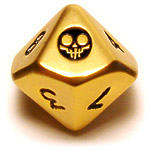
a regular minifig. Heroes have a Skill die of d10, are able to Move seven
inches per turn, and have an Armor rating of 2d6. With a cost of 11CP,
they're also a lot more expensive to field.
6.2: The Ego
The difference between a warrior who's merely phenomenally skilled and a
true Hero is a matter of Ego. No matter how high a regular
minifig's stat numbers may be, he recognizes the fact
that he'll eventually have to die, and that there are some rules that can't
be broken.
A Hero, by contrast,recognizes no such things. Mortality, logic, and the
laws of physics are beneath his notice. A Hero is above the concerns
of lesser minifigs.
Crankiness
Above all else, Heroes are the rock stars and prima donnas of the
battlefield, and each one insists on being more important than any other unit.
A Hero welcomes the presence of Enemy Heroes, because
any lesser foes are a waste of his abilities. He accepts Heroes on allied teams, because they give him rivals to compete with, and in any case he
expects to get to stab them in their Heroic backs as soon as his Human's
politics inevitably shift.
Placing additional Heroes on his own team, on the other hand, is a
major insult that no Hero can overlook. There can only be one star
of the show, and he doesn't like getting upstaged. If a single player fields
multiple Heroes, then their clashing Egos make each of them Cranky,
and the more Heroes there are, the Crankier they get.
For every other conscious unit on his team with an Ego, a Hero
receives a -1 Cranky Penalty, to a maximum Crankiness of -5. Any time
the Hero rolls one or more dice, whether for Skill, Armor, Damage,
Heroic Feats, or RedShirts, the Cranky penalty is subtracted from each die (total rolls can never be reduced below zero, however).
The penalty is not subtracted from dice rolled against the
Hero; he still receives full Damage from enemy attacks, for instance.
Penalties for Crankiness only remain in effect while the other Heroes
on the team are conscious. If the other Heroes are knocked out or
killed, the penalty is lightened accordingly. (If the Hero arranged to neutralize the co-headliners himself, all the better.) The penalty is reinstated if one of the dead or unconscious
Heroes is revived.
RedShirts
| “We can't all be heroes, because someone has to sit on the curb and clap as they go by.” |
| - Will Rogers |
A Hero is more important than any regular minifig. As a result, it's
only right that lesser troops sacrifice themselves to keep him from
harm. Whether out of love, duty, fear, or the Hero grabbing them by
the heads and using them as meat shields, a Hero can rely on nearby
allies to leap into harm's way to protect him from damage. These self-sacrificing
troops are called RedShirts. It's thought that they earn
the title by so often turning themselves into red splatter decorations for the Heroes' chests.
Any time a Hero takes Damage from an external source (not from
something internal like poison, coronary disease, or ingesting
a live grenade), he may try to inspire a nearby unit
to RedShirt. This does not take an Action. The Hero can inspire any
number of RedShirts in a single turn, but only one for each specific
incoming source of Damage. If successful, the RedShirting unit will leap in
to take the damage instead, knocking the Hero out of harm's way if
necessary (if the Hero is about to be hit by a speeding
locomotive, for instance, he'll need to be away from the tracks when the train rolls in).
The inspired unit must be on the Hero's team, it must be capable
of leaping (e.g., minifigs, robots, or animals, rather than tanks or jet
fighters), and it must have a lower CP cost than the Hero (not counting equipment).
When a Hero learns that he's about to take Damage, he has one chance
to inspire a nearby RedShirt to take the fall instead. Before the Damage is rolled,
the Hero rolls 1d6 (plus any Bonus Dice on a Critical Success). If an eligible RedShirt is within
this many inches of the Hero, the inspiration succeeds. The sacrificial
unit will leap in and take the damage intended for the Hero. If the roll is too low
or is a Critical Failure, the Hero fails to inspire the unit to RedShirt,
and is forced to take the damage himself.
If the Hero is in a Squad, other
Squad members are automatically inspired to RedShirt on his behalf, without having to make the inspiration
roll (Chapter 11: Armies).
If
the incoming Damage is too great to be blocked by a single RedShirt, the Hero is knocked away the minimum distance required
to avoid being hit (even if the distance required is truly riduculous,
like getting RedShirted out of a nuclear explosion or a supernova). This results in the Disruption of the Hero, unless he uses a Heroic Feat to stick an awesome landing.
| RedShirting should not be abused to try and accelerate units' movement across the battlefield. This will make a Hero's allies want to kick him in the nuts rather than sacrifice themselves for him. If a player attacks their own Hero to take advantage of RedShirting movement, the remaining players should take turns RedShirting the offending player out of the house and into traffic. |
RedShirts move unusually quickly and have no problem intercepting
gunshots, explosions, or even laser blasts. They're unconcerned with
whatever damage this might do to the laws of physics or to the Humans'
suspension of disbelief.
Heroic Deaths
| “This thing of being a hero, about the main thing to it is to know when to die." |
| - Will Rogers |
If a Hero dies in battle even despite the best efforts of his RedShirts, then he is dead - at least for the rest of the battle. But thanks to Everyone's The Boss Of Their Own Toys (1.4: The Spirit of the Game), Heroes have a way of always popping back up in one form or another, no matter how many times you think you've killed them. By the time the next battle begins, the plot will have inevitably twisted in their favor: the Hero was only captured in preparation for a daring escape, or left for dead in anticipation of a daring recovery. No matter how gruesome the death, they are somehow revived by magic, or science, or the will of the gods, or even as part of an enemy plot, and almost always with new improvements tacked on as a result.
If a Hero's death was so dramatically Heroic that it could never be taken back or plausibly denied, then the Hero may discover himself well and truly dead - and then proceed to slaughter his way out of Hell and back into the land of the living. His Ego will allow nothing less.
There is no number of deaths or defeats that can prevent the best characters from finding a way to return. Unless they're boring, in which case no force can save them.
|
"So the Warrior said:
Very well, since ye are a prince in this land, and because you did fight well,
I shall spare your life for a little while yet.
But thou has caused me to be cast out of the halls of mine fathers.
And thou has stolen from me that which I toiled for all the days of my life.
Therefore, tell me dark one; how is it that I may regain entrance to those halls?
And the daemon prince spake thus:
You can never enter that hall.
Unless thou should change thy name and go out once again unto the mortal wheel.
And thou must earn again the right to enter the halls of your fathers.
And this angered the Fearsome one.
And the daemon prince trembled at the sight of his countenance.
And he begged once more for his life.
So the Fallen one took hold of the daemon prince,
And he bound him into His armor, that he should still live.
And he took for His own the Hellblade as spoil.
And he did then depart from those burning hells to walk again the mortal realm."
- Excerpt from Tuefish's LEONIDUS Saga
|
6.3: Heroic Feats
A Hero's amazing abilities stem from both stunning bravado and pig-headed
ignorance, but his greatest powers are drawn from a tradition handed
down through endless generations of action movies.
Action-Hero Clichés
To realize their full potential, all Heroes must take on an Action-Hero
Cliché, drawn from movies, video games, comic books, or
Saturday morning cartoons. It is mandatory that Heroes develop
a ridiculous accent in support of their role. In a pinch, an Austrian
accent almost always works. If a role hasn't been played by Arnold
Schwarzenegger, it probably doesn't count as a real Action Cliché in the first place.
| If you're too young to remember Saturday morning cartoons, ask your parents. They won't be able to explain them either, but you can enjoy watching the looks on their faces as they feel another part of their childhoods die. |
| Example Action-Hero Clichés |
| Action-Hero Cliché |
Action-Hero Accent |
Example Action-Heroic Feats |
| Super Soldier |
Austrian / Stallonian |
Dual-wielding heavy machineguns,
performing surgery on self, punching through walls |
| Barbarian |
Austrian / Swedish |
Dual-wielding heavy axes,
lifting massive objects, communing with animals |
| Secret Agent |
Austrian / British |
Hacking security systems, seducing women/men,
sniping, escaping deathtraps |
| Kung-Fu Master |
Austrian / Chinese |
Dodging bullets, running up walls,
speaking in riddles |
| Pulp Archaeologist |
Austrian / All-American |
Dodging booby traps,
fistfighting Nazis, bullwhip expertise |
| Gunslinger |
Austrian / Texan |
Trick shooting, trick horsemanship,
trick gambling, trick dueling |
| Warrior Princess |
Austrian / New Zealander |
Chakram tricks, impossible acrobatics,
nerve pinches, lesbian subtexts |
|
For Heroes based on specific characters, picking the Action Cliché
is easiest of all: a Robin Hood Hero would perform Robin Hood Feats;
a Hercules Hero would have Herculean Feats, and a Davy Crockett Hero
would get King of the Wild Frontier Feats.
Action-Hero Feats
| “A hero is someone who rebels or seems to rebel against the facts of existence and seems to conquer them. Obviously that can only work at moments. It can't be a lasting thing. That's not saying that people shouldn't keep trying to rebel against the facts of existence.” |
| - Jim Morrison |
For an action-movie hero in the thick of battle, accomplishing the
impossible is more than just an everyday event - it's an every-couple-of-seconds
event. Any such stupendous or wildly improbable act, pushing fictional
license to its limits for the sake of spectacle, is a Heroic Feat.
Heroes are limited to the Feats appropriate to their Cliché. A ProWrestler Hero can't modulate phasers to energy-shield bypass frequencies
off the top of his head the way a ScienceOfficer Hero might, but he
can try picking up a motorcycle and swinging it like a baseball bat
through a group of opponents.
To attempt a Heroic Feat, the player describes the Feat their Hero is
about to attempt, and rolls 1d6. If one of his or her opponents would like
the Feat to fail (and they probably will), they also roll 1d6. (If more than one opponent would like to oppose the roll, the player chooses the one most negatively affected by the Feat.) If the
Hero's roll ties or exceeds the opponent's roll, the Feat
succeeds; otherwise the Hero's efforts end in failure.
| If both players roll a one in the Heroic Feat Roll, it's a special case - the Hero has failed to accomplish his Feat, but the opponent has simultaenously failed to oppose him. Rather than try to unravel this Heroic Paradox, the Heroic Feat is cancelled. The Hero suffers from a moment of uncharacteristic sanity and realizes that whatever he was about to attempt could never work. The Heroic Feat is spent for the turn, but play continues as if the Hero had never attempted it in the first place. |
A Hero may attempt one Heroic Feat on every turn. If he doesn't use
his Feat during his own turn, he may use it as a Response Action during
an opponent's turn at no penalty. Feats can't be "saved up" over
time - regardless of whether a Hero uses his Feat or not, he will always have a single Heroic Feat available at the beginning of his next turn.
The Consequences of Failure
| “... if he fails, at least he fails while daring greatly, so that his place shall never be with those cold and timid souls who know neither victory nor defeat.” |
| - Theodore Roosevelt |
Because the range of possibilities for each type of action hero is
so wide, it's up to the players to agree on whether a specific Feat
is appropriate to a given Cliché, what the effects of success
will be, and what will be the consequences of failure.
The effects of failed Feats will depend on the seriousness of the
battle and the attitudes of the players. A good general guideline
is that the more stupendous the Feat attempted, the more dire the
effects if it fails. A Hero failing an attempt to eat a dozen doughnuts
in a single turn might suffer the effects of upset stomach. Choking
to death might be a more realistic result, but it'd seem severe
compared to the relatively uninspiring Feat. A Hero failing to lift
an automobile over his head, on the other hand, would be subject to
much stronger consequences on failure: he might get it into the air
but then drop it on himself, or he might strain so hard to lift it
that he rips his own arms off. If all else fails, imagine
what would happen to Homer Simpson, Wile E. Coyote, or the Three Stooges if they were to make similar attempts.
| Inaction Heroes |
Heroic Clichés are based on Action Heroes, not Word Heroes. Heroic Feats must always be based on actions rather than words. If a Hero wants to inspire his allies, he does it by leading a Charge, not by delivering pretty soliloquies about the nobility of Charges while sipping tea in the safety of the rear guard.
If players decide that a Hero's Heroic Speech is Heroic enough to ignore this rule, then they can decide to allow it, despite the unbelievable lameness of Speech Feats. But if the speech fails to inspire, then it means the Hero is no longer inspiring, and an uninspiring minfig loses his Hero status automatically and permanently. "Word Heroes" are justly de-Feated and deserve the agony of that loss.
In addition to not being Word Heroes, Action Heroes are also not Inaction Heroes. They ESPECIALLY can't use Feats to inspire others to withdraw from combat safely, negotiate more diplomatically, or surrender more sweetly. They exist to increase action, not diminish it. |
6.4: Heroic Weapons

| Before becoming the leader of the Metal Warriors, BFenix first had to satisfy the Gods of Metal and claim the forgotten blood sword RAGE in the Steelliums of Hellius. |
| Character by BFenix |
|
Long after Heroes have decomposed into component plastic parts, their legendary accessories live on, inspiring new generations to avaricious conflict. Many such Artifakts are powerful enough to give regular minifigs Heroic abilities all by themselves. Magical swords, enchanted armors, deific grails, zero-point blaster cannons, and unusually well-stocked gift bags have all inspired campaigns of slaughter from covetous Hero wannabes.
Heroic Weapons are the most common type of Heroic Artifakt, but legends are also told of Heroic Vehicles, Heroic Armor, Heroic Fortifications, and even Heroic Furniture. Any object can be made Heroic for an added cost of +3CP. These objects retain all the regular uses of an object of their type, but also grant one Heroic Feat per turn to whomever posesses or operates them.
Whoever takes possession of a Heroic Artifakt can use it in a Heroic Feat as part of any Action taken with the Artifakt, making it dangerous to leave Artifakts lying around on the battlefield or in the hands of easily-defeated amateurs.
A Heroic Artifakt
is limited to Feats that satisfy its Heroic Cliché, similar to that of a regular Hero, but Artifakt Clichés tend to be simple tautologies. Excalibur's Cliché, for example, is that it's Excalibur.
Heroic Artifakts suffer no penalties from Crankiness themselves, since anyone can use them, but they may inspire Crankiness in minifig Heroes on the same team if the Heroes don't have Heroic Artifakts of their own.
A Heroic minifig using a Heroic Artifakt is still limited to one Feat per turn, but with the following advantage: If the Feat satisfies both his own Heroic Cliché and that of the Artifakt's, then he can roll two d6es instead of one when rolling for his Feat, succeeding if either of the two d6es matches or exceeds his opponent's opposing roll.
|
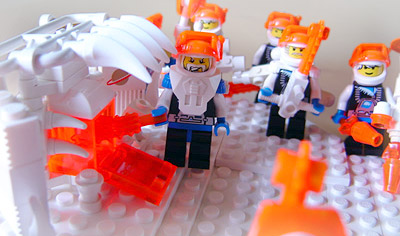
Orange Transparent ABS is the most powerful substance known to minifigs. The only source of this material is the frigid planet of Iceworld, where ancient crusades against Robotic Ice Daemons dropped the temperatures to far below absolute zero.
Under these impossible and supernaturally cold conditions, even laser beams froze, rendering all of the crusaders' weapons useless, save one: the planet-destroying Orange Laser. Thanks to its massive scale, a central core of destructive energy was able to punch through the cold, even as the outer layers of the beam froze solid and peeled away.
Bazillions of years later, the frozen shards of petrified laser remain preserved under continents of shifting ice, retaining all of their ancient world-destroying power for anyone with the secret knowledge and will to forge them into weapons.
The world-destroying fleets are lost and long forgotten, but the crusaders' descendants remain on the planet surface, locked in never-ending battles to prevent a Robotic Ice Demon resurgence and to protect the secrets of Orange Transparent Leg-Ore from falling into the wrong hands. In this quest, the Orange Transparent Chainsaw is their deadliest and most legendary weapon.
|
|
|